Hephaestus, god of craftsmanship, blacksmiths and fire
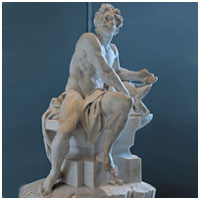 Hephaestus (Vulcan) was a god of craftsmanship, blacksmiths and stonemasonry. He was the discoverer of craftsmanship, mostly working with fire and metals such as gold, silver, copper and iron, testing and making all sorts of alloys. He eventually surpassed all the gods in craftsmanship and was offered prayers and sacrifices by craftsmen before any other deity. Due to mastering the use of fire, he also became known as the god of fire. Hephaestus had his own palace at Olympus, containing his workshop with an anvil, which stood out from the rest of the gods but this was not his only home.
His other home was on the island of Lemnos, which was sacred to the god, and where he worked at his forge alongside his apprentice, Cedalion. Another workshop was in a cave at the island of Lipara near Sicily where the Cyclopes were stationed. It is said that the god even leveraged the chaotic fires of defeated and melted Typhoeus in Sicily. Apart from constructing houses for all the gods of Olympus and some of the heroes, Hephaestus crafted plenty of marvelous items, weapons, shields, armor components, decorations and jewelry. He was also credited with forging most of automatons, animated creatures specified for performing certain tasks.
Appearance in the works of art
In the art works, he was usually depicted as a fully grown bearded man in a working suit, holding a hammer and tongs. He often presented his accomplishments to other gods.
Myths of Hephaestus, his life, marriage and inventions
The following grouped sections are available:
- Expelled from Olympus and his return
- Rejected by Athena
- His Descendants
- The Inventions of Hephaestus
- Marriage with Aphrodite
- Trojan war
- Other myths
Expelled from Olympus and his return
Hephaestus was a son of Hera without the help of Zeus. It is said that Hera was angry at Zeus for giving birth to Athena on his own and she refused intimacy for a year and gave birth to Hephaestus.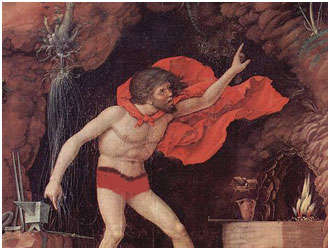 Alternatively, he was a descendant of the kingly marriage of Zeus and Hera. He was often described as lame, deformed and not appreciated by the parent or parents. He was cast out of heaven because he rescued Hera from bonds when Zeus hung her from Olympus for sending deadly storm over the ship which Heracles was sailing on. After entire day of falling, Hephaestus landed on Lemnos and crippled his legs, almost died in the process, but Thetis and Eurynome saved him. He dwelt with them for nine years in a grotto surrounded by Oceanus, improving his skills, making necklaces, earrings, bracelets and brooches.
After years of crafting and mastering the skill, he built a golden chair with invisible fetters or, alternatively, adamant sandals and sent the gift for his mother to Olympus. When Hera sat on the chair, or tried out the sandals, she triggered the trap and found herself bound. The gods were unable to release her and asked Hephaestus to free his mother but he refused the request, denying that he had a mother.
He wouldn't listen to any of them except Dionysus who offered him wine during debate and, when Hephaestus was drunk enough, brought him before the council at Olympus. Zeus would offer him anything, if he was to release Hera. Before the lame god could make up his mind, Poseidon urged him to ask for the hand of Athena and it was granted but the goddess defended her chastity.
Rejected by Athena
Shortly after the return to Olympus, according to Hyginus' Fables, Hephaestus entered Athena's chamber and wanted to embrace her but the goddess protected herself with arms. As they struggled, the lame god got excited and some of his seed dropped to the earth and from it Erichthonius was born.
Alternatively, according to Apollodorus' Library, Athena came to Hephaestus with a request of fashioning arms for her. Clouded by the love spell of Aphrodite, Hephaestus fell in love with Athena and began to pursue her but she would not submit to him. When he got close enough, he tried to enter her by force but Athena was able to prevent him and the lame god leaked his seed on her leg. Disgusted by his act, she wiped the seed with wool and threw it on the ground. Athena fled away and from the earth Erichthonius was born. He was described as a boy with a serpent like lower part of the body. Athena felt responsible and cared for him in secret, entrusting him to the daughters of Cecrops.
His descendants
Some sources claim that Erichthonius was a son of Hephaestus and Athena while others attributed Gaea (earth) as the mother or in one case even Atthis, a daughter of Cranaus. The god, even though he was lame, managed to conceive more sons. Periphetes, who was also deformed in one leg, was said to be his son by Anticlea.
The other sons were Cercyon, Cecrops, Corynetes, Philottus, Spinther, Olenus, Ardalus and Palaemon.
The Inventions of Hephaestus
The god was famous for his inventions, crafting many pieces worth mentioning. One such piece was the fearful aegis with double fringe that scared people away from war. It was made for Zeus and used by Apollo during the Trojan war. For Apollo, he made a chariot with golden axles and golden tires with silver rods that enhanced the shining effect of the sun god. For Apollo and Artemis the god crafted silver arrows, a staff for Agamemnon and a robe and necklace for Cadmus, which the hero gave to his wife as a wedding present.
On the request of Thetis, the mother of Achilles and the god's close friend, Hephaestus forged the famous shield of Achilles.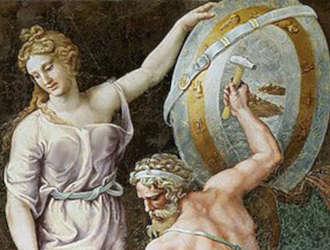 It had five layers of protection and rich design featuring lands, seas, heavens, constellations, cities of men during the war and during feasts and weddings. To Thetis the god also gave a golden two-handed jar, which she later used for her son's funeral. Heracles was given a golden breastplate and a war club by Hephaestus directly and brazen castanets by Athena, all made by the smith god while Diomedes was said to be wearing body armor, a special corselet, made by the god.
Hephaestus was also credited with crafting two fire-breathing bronze bulls of enormous size and gave it as a gift to King Aeetes. These automated creatures were known as Colchis Bulls or the Khalkotauroi. For the king of Colchis he also decorated his palace with four magical fountains that were producing wine, milk, oil and hot water.
Hephaestus also crafted immortal gold and silver dogs that stood at the entrance of the palace of Alcinous and guarded the area. As he was always very busy, the god crafted twenty self-automated tripods with golden wheels under the legs which could, at his command, attend the gathering of the gods at Olympus and then return back to his house. At his command were also female servants made of gold, helping him with projects at the forge. Another automaton of gigantic size was Talos, by some considered to be made by Hephaestus and gifted to Minos. To others, the giant was a remnant of the brazen race of men.
There were more items, such as a bronze bowl which was placed in the temple of Apollo in Patara, a silver mixing bowl with rims of hammered gold, given to Telemachus by Menelaus and framed the image of Dionysus which was painted by the god himself.
Marriage with Aphrodite
Hephaestus eventually got married to Aphrodite, sanctioned by Zeus for a huge golden cup, a masterpiece work, brought to him by the smith god. However, this marriage was bound to fail from the beginning as Aphrodite fancied Ares and the spark was mutual. They had an affair and were taking action right there in the palace of Hephaestus. However, this affair had not gone unnoticed because Helios, the titan god of sun, randomly spied on the couple one day and immediately reported it to lame god.
In fury, Hephaestus went to his workshop, brooding revenge. He made a magical net to trap the couple in action. The next time, before announcing a trip to Lemnos, he went to his marriage chamber and organized the snare around the bed. Then, after he departed, Ares came to make love with Aphrodite. As soon as they lay in bed, the net of magical chains enveloped them and they could not escape.
Meanwhile, Helios reported everything to Hephaestus and the god of craftsmanship was already on his way home, frustrated and angered. He called all the gods and goddesses to come and see this infidelity. Goddesses were said to be too ashamed to attend but the gods came. Observing and listening to Hephaestus complain about life being unfair, how he was born deformed and lame and Ares being healthy and beautiful, they started laughing.
All of them except Poseidon who demanded Ares to be released from bonds. Hephaestus rejected the demand at first but then, after Poseidon's promise of appropriate punishment, released the couple. Because of this adultery, Ares was banished from Olympus. Aphrodite, on the other hand, departed on her own and went to Paphos in Cyprus.
Trojan war
During Trojan war, Hephaestus saved Idaios, a Trojan warrior, by covering him in a dark cloud when he fled away from the chariot and was about to be killed by Diomedes, who moments ago killed his brother Phegeus. Hephaestus favoured the brothers and their father Dares because he was the god's priest. He also calmed down his mother Hera and advised her not to oppose Zeus when a quarrel about the war broke out among gods.
When the gods were allowed to pick a side and intervene on the battlefield, Hephaestus joined the Greek camp and intervened against the actions of the river god Xanthus (Scamander) who was trying to drown Achilles in his stream of blood and corpses. In fear of losing Achilles, Hera called her son to aid and oppose the river with fire, telling him to be ruthless and to disregard any threats or gentle words.
Hephaestus created a massive blaze of fire, burning the plains and torching all the bodies on the river stream, to clear the way for Achilles and then focused his powers on the stream, burning everything else left in it, and even the the river itself, forcing it to subdue. The fighting spirit of Xanthus was finally broken and Hephaestus was told to cease the fire to prevent further harm to the river god and consequently to people.
Other myths
Hephaestus, yet with another of his crafty inventions, chained Prometheus to Mount Caucasus, when he was punished by Zeus for stealing back fire for mankind.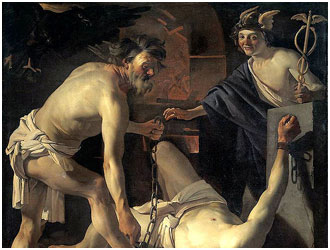 To further punish the titan god, a giant eagle, thought by some to be the work of Hephaestus, was sent to eat his liver. To punish humanity for the stolen fire, the lame god was tasked by Zeus to create a woman. Hephaestus made her out of earth and clay, filled with water, and infused her with a human voice and vigor and made her face like immortal goddess. Athena clothed her with silvery raiment and embroidered veil. Her name was Pandora and it is said that Zeus gave her a forbidden jar and married her to Epimetheus, the brother of Prometheus.
Hephaestus also helped delivering Athena from Zeus' head. The king had an affair with Metis and later ate her in fear of Hera. The lame god was summoned when Zeus was experiencing a severe headache that he couldn't get rid of. Upon opening his head with a hammer, Athena jumped out, fully grown and dressed in armor.
In another account, The god once, at Hera’s bidding, ceased his work at the forge, allowing the smoke to clear so that the Argonauts could pass safely on their voyage. During Gigantomachy or the War of the Giants, it is said that Hephaestus killed the giant Mimas with metal missles and was later transported by Helios away from the battlefield because he was drained from using his powers.
Sources
To learn more, you may explore the sources and notes about Hephaestus yourself