Zeus, god of sky and heaven
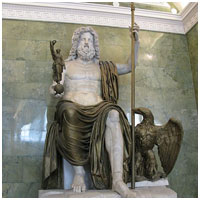 Zeus (Jove, Zen, son of Cronos, Jupiter) was a god of the sky and heaven, who controlled lightning and the thunderbolt, and easily manipulated weather to his own accord. He was also known as the King of the gods and father of gods and men as he influenced the natural law and order of the Cosmos. Zeus oversaw all affairs because the ultimate authority belonged to him. Although he could pretty much intervene in every decision made by any of other gods, he had no control over the fates or love. Zeus was superior to the rest of the gods in strength, spirit, wisdom and justice and was a rightful and just ruler whose divine order enabled everlasting prosperity.
He was the first to introduce rules regarding acts of injustice, in order to deal justly with one another and refrain from violence. Zeus himself enacted these rules, easily humbling the proud and raising the obscured when acting in justice, thus promoting fair practice and honest judgment among communities.
He was said to have visited all the inhabited earth, introducing equality and democracy, and got rid of thievery and impiety. Those who embraced violence, corruption and injustice were met with hardships, Zeus could even cast famine and plague to entire lands and put groups or individuals on a difficult trajectory towards demise or redemption.
As a father, Zeus cared very much about his children and protected his family, often intervening and making peace between them. Despite being almost a perfect icon in the Greek culture, he was known to be quite naive and fearful in many of his numerous love affairs and that made him very unpredictable and completely out of character.
Appearance in the works of art
Most of the time, Zeus is depicted as a grown man with a beard and longer curly hair, holding an eagle in one hand and a thunderbolt in the other, wearing a crown made of spring flowers. Sometimes, he is also depicted as a young man or holding thunderbolts in both hands.
Myths of Zeus, his birth, throne, influence and relationships
The following grouped sections are available:
- Birth of Zeus and early life
- Titanomachy
- Attempts to dethrone him
- Love affairs and his descendants
- His sacred animals
- Maintaining peace and harmony
- The great flood
- Punishments of Zeus
- Gifts and blessings
- Trojan war
- Other myths
His birth and early life
Things were set in motion even before his birth that threatened his very existence. His father Cronus was given a prophecy that he would be dethroned by his children. In fear of losing his throne, Cronus forced his wife Rhea into giving him children the moment they were born and ate them, thinking it would undo the prophecy.
It had quite the opposite effect because Rhea grew angry and frustrated when her husband robbed her of motherhood. Having already eaten Demeter, Hestia, Hera, Hades and, variously, Poseidon, she decided to give birth to Zeus in secret and gave Cronus a stone, wrapped in swaddling clothes, to swallow, thinking it was his child.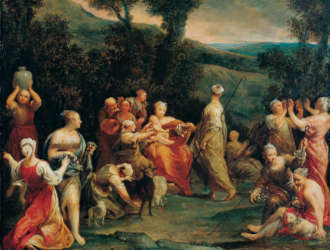 The real baby, however, was hidden away, brought to the cave of Dicte and given to the Curetes and nymphs of Adrastia and Ida to be nursed and taken care of. The nymphs fed him with the milk of Amalthea, the famous goat, and Curetes guarded him in the cave, masking his crying voice by clashing spears on their shields so that Cronus, having realized the stone trickery and was again on the lookout, wouldn't be able to hear him. As Zeus grew, his greatness grew with him and it soon became obvious and undeniable that he possessed strength and wisdom beyond all other gods. He was special and destined for glory.
After reaching adulthood, he returned to Mount Othrys and with the help of Metis, a daughter of Oceanus, forced his father into vomiting and disgorging his brothers and sisters. They named Zeus their leader and together they rebelled against Cronus and the Titans which led to a ten-year war, also known as the War of the Titans or Titanomachy.
This is the most accepted version of the myth among authors, however, different versions of his birth can be found. According to the Arcadians, in the Pausanias' Descriptions of Greece, Rhea, while pregnant, took refuge to Mount Lycaeus, also called Cretea, and made allies with the Methydrians who helped her deliver Zeus in secret. The same mountain was the very spot where the exchange of the stone in swaddling clothes to Cronus had happened.
According to the same author, the newborn Zeus was bathed in the river Lusius which became known as the Bathing River. At birth, eight local nymphs were present, Oenoe, who held the baby, Glauce, Anthracia, Alcione, Phrixa and the three nurses, Theisoa, Neda and Hagno.
Alternatively, according to Messenians, in the Pausanias' Descriptions of Greece, Zeus was taken by the Curetes, in fear of Cronus, from Crete and brought to Mount Ithome to live among the local nymphs and be nursed by Neda and Ithome.
In another version, according to Hesiod's Theogony, Gaea brought Zeus, after his birth, to Lyctus in Crete first, only then hid him in a remote Dictean cave on Mount Aegeum, or, according to Hyginus' Astronomica, Zeus was taken from Crete to Naxos where he was nourished in secret.
When Zeus was still an infant, it is said, in Diodorus Siculus' Library of History, that omphalos, the umbilical cord, fell from him near the river Triton and marked the spot as sacred. He also founded the city of Dicta to honor his birthplace.
Titanomachy
What followed was a series of battles against the Titans in a ten-year war. For majority of the years, things looked bad for the younger gods who were overwhelmed by the titans, led by Atlas. Zeus knew that they were in serious need of aid and was prophesied by Gaea that the war could only be won allying with those imprisoned by Cronus.
Zeus acted quickly and traveled to Tartarus where he slew Campe, the guardian at the gates of this unforgiving pit, and released the Cyclopes and the Hekatoncheires. He helped them escape from Tartarus and brought them to the surface where they forged an alliance against Cronus and the Titans. The Cyclopes crafted three magical items for the three brothers, Zeus receiving the most powerful weapon of all, the thunderbolt.
Zeus then unleashed the full extent of his powers against the Titans, the battle was said to be catastrophic, disrupting the cosmic order of heaven and earth, as thunderstorms and blazing fire covered the sky and immense violence shook the earth, seas and forests. Zeus was said to had fought Menoetius who was struck by a thunderbolt and cast directly into Tartarus. The Hekatoncheires overwhelmed the Titans by hurling massive rocks at them with each of their hundred hands until they were all cast into Tartarus, all but Atlas who was punished with holding heaven and earth apart for eternity.
Alternatively, according to Hyginus' Astronomica, Zeus was prophesied that to win the war, he would need to carry the Aegis, the skin of the goat, and the head of the Gorgon. Later he cast Panikos (Fear) into the enemy and seized victory with the help of Athena, Apollo and Artemis.
After the victory, according to Apollodorus' Library, Zeus and his brothers, Poseidon and Hades, drew lots over the sovereignity of the dominion of the Sky and Heaven, the Sea and the Underworld, and Zeus got the realm of the Sky and Heaven. He became a new ruler of the Cosmos and a king of the Olympian gods.
Alternatively, according to Callimachus' hymn to Zeus, he earned his kingship through his own deeds and superiority, rather by his excellence than by a chance drawing lots. It is also said, according to Hesiod's Theogony, that Zeus fairly distributed to the immortals their portions and declared their privileges after the victory over Cronus. Only then, he claimed the throne.
Attempts to dethrone Zeus
In several accounts during his reign, an attempt was made to overthrow the king of the gods. The first was when Gaea grew frustrated with the rulership of Zeus and her direct descendants, the Titans, being imprisoned in Tartarus. She sought to overthrow the order of Zeus by giving birth to a new generation of Giants and urging them to rebel against the Olympian gods which resulted in the War of the Giants, known also as Gigantomachy.
Before the war, a divine plan was revealed to Zeus, after making a sacrifice to the ancient gods, that they would need help from a mortal hand, if they were to defeat the giants.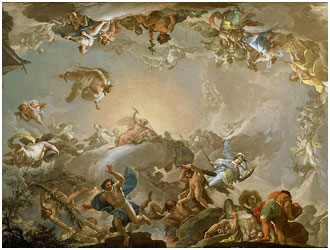 It happened to be Heracles who came to assist the gods and, with Athena's guidance and Zeus' thunderbolts, was able to overcome the two most powerful giants, Porphyrion and Alcyoneus. Zeus was said to had struck Porphyrion with a thunderbolt, saving his wife from being violated by the giant. When Porphyrion was stunned by the electric shock, Heracles siezed the opportunity and ended his life with an arrow which was also the case for many other giants, after being smitten with thunderbolts. Zeus was also said to had slain giant Mylinus in Crete.
This, however, was only the first wave of the rebellion because out of anger and pain, Gaea gave birth to a far more dangerous and monstrous colossal giant. Of all the giants, Typhoeus was the strongest and so huge that his head was said to have brushed the stars. One hand reached to the west, the other to the east and attached to these were hundred heads of serpents. Despite his size and appearance that instilled fear among all gods when he directly attacked Olympus, Zeus fought bravely and even though he was overpowered and stripped of his powers at first he didn't give up.
After his powers were restored, Zeus fought Typhoeus again and was finally able to defeat him in a great battle, where the earth shook and water boiled. In the end, when Typhoeus disintegrated over the plain of Nysa or was cast into Tartarus, Zeus punished the giants for waging the war against gods and treating mankind in a lawless fashion, enforcing their superiority in size and strength against them. He also rewarded the noblest of gods and heroes and men that helped winning the war and honored him as the everlasting king that dwelled on Mount Olympus.
There was another attempt that challenged the throne when Hera, Athena and Poseidon rebelled against Zeus and tied him up to a chair. He was saved by Thetis who summoned his ally Briareus, one of the Hekatoncheires. When he came and sided with Zeus, the plot ended immediately, resulting in him being released from the chair. It became obvious to every deity that his supremacy stemmed not only from being the strongest and wisest of them all, but also from his ability to maintain harmony among the gods and from the many allies he gained during difficult times.
Love affairs and his descendants
Divine descendants
In his life, he was known for having numerous love affairs. His first love was Metis, a daughter of Oceanus. Zeus pursued her in his young age and got her pregnant. Because of the prophecy that he would lose the throne to his firstborn, he swallowed Metis, the same way his father Cronus had done. However, this didn't prevent Athena from being born, as she later jumped out of his head as an adult, dressed in armor.
He also mated with Themis who gave birth to Horae (hours) and Moirae (fates). With Mnemosyne, he fathered nine Muses and with Eurynome, a daughter of Oceanus, three Charities (graces). With Demeter he fathered the maid Persephone, who would later, also by Zeus, give birth to the first incarnation of Dionysus and, variously, to Styx. Zeus had his eyes set on both daughters of Coeus. First, he pursued Asteria but she managed to escape his advances. With her sister Leto was a different story, he charmed her and got her pregnant. Later she gave birth to important twin gods Artemis and Apollo.
Zeus considered Metis, Themis, Mnemosyne, Eurynome, Demeter and Leto his wives but the only true wife was Hera who was courted by Zeus in her maidenhood. It is said that Hera once left Zeus in anger and refused to return. On Cithaeron’s advice, Zeus tricked her into thinking he was marrying another woman by parading a wooden image disguised as a bride. Though shocked at first, Hera laughed when she discovered the ruse and reconciled with him. They eventually got married near the river Theren, somewhere in Crete. Hera then gave birth to Hebe (Ganymeda), Ares, Eileithyia, and variously to Hephaestus and Eleutheria. Some authors were attributing Hephaestus as Hera's child without a father as a painful revenge to Athena's birth.
Being officially married didn't stop Zeus from keep falling in love with other women or being faithful. The only difference was that from now on, he would try to hide his affairs. One such affair, hidden away from the public eye, was Maia, one of the Pleiades, daughters of Atlas, who dwelled in a secluded cave on Mount Cyllene. He mated with her in secret and she then gave birth to Hermes who was very soon after his birth appointed as a personal herald of Zeus and the deathless gods.
A mortal woman Semele wasn't so lucky when Zeus fell in love with her and mixed her a tonic with the heart of the first Dionysus who was dismembered by the Titans. He got her pregnant with the god Dionysus whose true identity was only revealed after much turmoil because he was pursued, along with his mother, by jealous Hera who found out about the affair.
There was also Io, a priestess of Hera, who Zeus impregnated and then transformed into a white cow to hide his acts. Hera, however, suspected the affair and demanded the cow for herself. She ordered Argus, the sleepless giant, to watch over the cow. Hermes later killed Argus and liberated Io who then, in the shape of a cow, roamed the world until she gave birth to a son Epaphus.
Depending on the source, Aphrodite was also a daughter of Zeus by titaness Dione, a daughter of Uranus and Gaea, so according to Homer for example, whose Aphrodite and Hephaestus were children of Zeus, he basically fathered the whole second generation of Olympian gods.
The other divine descendants were Aegipan by Boetis, Britomartis by Carme and Xanthus, the river god. Zeus also courted goddess Thetis but withdrew his pursuit after hearing the prophecy that her son would be more powerful than his father. Thetis was then married to Peleus or, alternatively, to Aeacus.
Mortal descendants
Most famous among mortals was Heracles. It all began when Zeus fell in love with Alcmene. She, however, refused his advances because she was unwilling to break her bond of marriage. Zeus then he took the shape of her husband Amphitryon, tricking her into making love with him. When he laid with her, he made the nights three times longer and it is said that the magnitude of the extended time for procreation enabled extraordinary strength of the child. When Zeus announced that the firstborn would be crowned king, Hera made sure that Eurystheus, the son of Amphitryon, was born first. Zeus was reluctant but couldn't argue against his will. Instead he convinced Hera to at least agree that Heracles, who was born after Eurysheus, should then serve his brother and king.
A mortal woman by the name Danae was desired by Zeus but since she was imprisoned by her father Acrisius, Zeus couldn't get hands on her so easily. So he came in the shape of a golden shower, which rained through the bars above her head, and impregnated her. She then gave birth to Perseus but Acrisius didn't believe her story about what happened. Consequently, he put his daughter and the child in a chest and cast them out into the sea.
The Discouri, the twin brothers were also known as the sons of Zeus by Leda, although, according to Hyginus' Fables, Castor came from the seed of Tyndareus, Leda's husband, while Pollux was the true son of Zeus. Pollux refused to accept immortality when his brother died and begged Zeus to die as well so they would be able to live together in the underworld. Zeus was moved by the request and allowed them to share immortality and death, meaning they could forever spend one day on Olympus and the other in the underworld.
Then there were three famous sons Minos, Rhadamanthys and Sarpedon born to Zeus and Europa. All of them were kings at one point, Minos and Rhadamanthys were both kings of Crete while Sarpedon was granted the kingdom of Lycia and a lifespan of three generations.
Another son of Zeus was Aeacus by Aegina. When Aegina was taken by Zeus, her father Asopus was said to have pursued Zeus to get her back but was stopped by a series of thunderbolts hurled at him.
Another famous child, a daughter of Zeus, was Helen, the most beautiful woman on earth, who hatched from an egg and whose love Paris desired, which set things in motion for the Trojan war. Zeus had her with Nemesis or, alternatively, with Leda.
Then there was also the nymph Callisto who was transformed into a bear either by Zeus to hide his acts from his wife or by Hera herself when she found out about the affair when Arcas, a son of Callisto and Zeus, was born, or even by Artemis who transformed her because she got pregnant.
Zeus had many more children, such as Iasion, Dardanus and Harmonia by Electra, Tantalus by Pluto, a daughter of Himas, Spartaeus, Cronius and Cytus by Himalia, Lacedemon by Taygete, Pirithous by Dia, Megarus by the Sithnid nymph, Sybil by Lamia, a daughter of Poseidon, Aethlius by Protogenia and Perithous.
His sacred animals
The sacred animal of Zeus was an eagle which he often sent as a sign of approval to mortals. Once he set two eagles free and they flew from the opposite directions, one was coming from the east and the other from the west, and they met at the spot which marked the navel of the earth which was no other than the sacred temple of Delphi. It is said that Zeus was fascinated with the animal when he saw it while sacrificing and preparing for the war with the Titans. So fascinated that the eagle was immediately placed among stars.
His other sacred animals were bees, which he made insensible to the wind and temperature so they could cover ground in higher altitudes and endure tough weather conditions. As a memorial to these beautiful and the most productive creatures, Zeus changed their color to like copper with a gleam of gold.
Maintaining peace and harmony
The life of Zeus at Olympus and beyond was not easy, he had to maintain the harmony and keep peace among different characters that sometimes had conflicts of interest. Luckily, he had help from Themis, his counselor, who whispered him the words of wisdom and Ganymede who was for the sake of his beauty brought to Olympus as a cupberarer by Zeus personally. He gladly served the king with ambrosia and nectar during assemblies and in his free time.
Sometimes the king had a tough decision to make, such as the decision to pick the fairest goddess among Aphrodite, Athena and Hera who were all very dear to him. He thought that the wisest thing was to pass the decision to Paris Alexander but even he couldn't forsee that this decision would bring further conflict and war.
Zeus also had to adjourn that Persephone should return to Olympus when her mother Demeter caused famine over lands because Hades abducted her and brought her to the underworld as her wife. Hades, however, tricked Persephone into eating a pomegranate which bound her soul to the underworld forever and she had to return every half year.
In another account, to end the quarrel between Aphrodite and Persephone, Zeus adjourned that Adonis, a beautiful mortal youth, should spend one third of the year in the underworld with Persephone, one third of the year on Olympus with Aphrodite and the rest according to his own will. Adonis chose to spend his own time with Aphrodite.
There were also more heated quarrels that needed direct interventions, such as Idas and Apollo fighting over a woman's hand. Zeus had to part them and adjourn that the maiden herself should choose which of the two she would marry. Zeus also parted Heracles and Apollo fighting over the sacred tripod of the oracle of Delphi when the hero was denied an oracle and wanted to steal the tripod to institute his own oracle. After intermediary from Zeus, Heracles was given an oracle by Apollo which settled the conflict. Similarly, Zeus parted Poseidon and Athena during the quarrel over the land of Attica and appointed arbiters to adjourn justly. The land was later given to Athena.
There was also a case when Zeus needed to act immediately and part Ares and Heracles with a thunderbolt. Ares was in rage and wanted revenge when Heracles killed his son Cygnus. Ares confronted the hero with violence and dominated the battle that would most likely end with the death of Heracles without the intervention.
The Great flood
Zeus is said to had ended the bronze age with the Deluge or the Great flood. His reasons behind such action were in the brazen race who were very warlike and cherished the works of destructive Ares. The tipping point, however, was the cruel and impious ways of certain individuals, a total disrespect shown towards gods.
It all started when Lycaon, a king of Arcadia, hosted Zeus in his house and tried to murder him in his sleep. To make matters worse, Lycaon sacrificed a Molossian hostage and served the boy's meat for dinner. These kinds of sacrifices were forbidden in the new Olympian order. Zeus was angered and struck down his house with thunderbolts and transformed Lycaon into a wolf, who ran away in terror, still thirsty for blood. Zeus, shocked about these cannibalistic offerings, decided that mankind was cursed and needed to be destroyed.
Rather than fire, he chose to bring down endless rain and, with the help of Poseidon, bring forth rapid rivers and restless sea waves.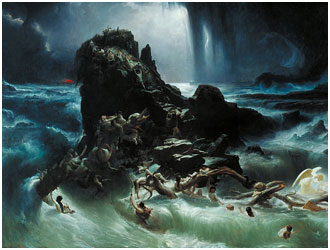 A great deluge gathered on the horizon, ready to bring about the end of days. Prometheus, however, was aware of this beforehand and warned his son Deucalion to prepare himself for the deluge. He took Pyrrha, a daughter of his brother Epimetheus, along with him to the safe location and it is said that they were the only ones who survived the cataclysmic event. Once the rain stopped and the waves ceased, Deucalion prayed to Zeus and was granted a prayer to choose his future. He chose to create men and, following Zeus' instructions, he created them by throwing stones over his head. Same way, the stones which Pyrrha threw over her head, became women.
Punishments of Zeus
By Thunderbolt
One of the quickest and most efficient ways to punish individuals was with a thunderbolt, the strongest divine weapon in Greek mythology. Zeus used it in the past to win wars and battles against the toughest of opponents and would use it instantly with precision to enact his divine will.
One such individual was Salmoneus who pretended to be Zeus and demanded worship and sacrifices in the city of Elis which he founded. Because of impeity and false peity, Zeus struck him with a thunderbolt and wiped out the city with all the false worshippers.
Another was Asclepius, a son of Apollo, who discovered healing methods to bring people from certain death which diminished the arrival of the dead to the underworld. Zeus slew him with a thunderbolt which angered Apollo who then in revenge slew the Cyclopes, allies of Zeus, who forged the very same weapon. Apollo was then sent in servitude to Admetus as a punishment.
Phaethon, a son of Helios, was struck by the thunderbolt because he set earth on fire when he foolishly drove his father's chariot too close to the earth.
Another one was Anchises who told his companions of his son Aeneas over a cup of wine, a secret that he was told not to divulge to anyone by Aphrodite.
The other ones struck with thunderbolts of Zeus were Iasion who tried to violate Demeter, Tityus, a giant sent by Hera, for trying to violate pregnant Leto, Capaneus for wanting to conquer Thebes against the will of Zeus. the house of Lycaon with cannibalistic sons inside for cannibalistic practices and corrupt worship, and Erechtheus on Poseidon's request.
By Spells and Transformation
Zeus punished Theseus and Pirithous, for taking Helen and exposing her to danger, by casting their spirits into a dream state, instructing them to travel to the underworld and ask Hades for Persephone's hand on behalf of Pirithous.
Alcyone and Ceyx were punished for boasting of having Zeus and Hera as a husband and a wife. They were transformed into birds, Alycone into a kingfisher (alcyon) and Ceyx into a gannet (ceyx).
A certain dog that was destined to catch every pray it pursued once encountered a fox that was destined to escape every predator. Having to solve the paradox, Zeus punished both by turning them to stone.
A famous seer Phineus, who was given the gift of prophecy by Apollo, once revelead divine plans to mortals which was against the will of Zeus who then blinded Phineus and brought lingering old age upon him.
Zeus also brought misfortune and hostility was towards the house of Atreus, including the murder of Agamemnon by his wife Clytemnestra.
Atalanta and Hippomenes were transformed into a lion and lioness by Zeus, animals that were denied intercourse by the gods, because they laid and made love in the shrine of Zeus on Mount Parnassus
Special punishments
Zeus once put his wife Hera in bonds and hang her from heaven for sending a storm that almost killed Heracles when he was on route from Troy. He also cast Hephaestus out of heaven when he released Hera from bonds.
The titan Prometheus was chained to Mount Caucasus for thirty thousand years for giving back fire to mankind, previously revoked by Zeus because he was tricked by Prometheus into choosing the more appealing meal to the eyes but with mostly bones inside. The other meal, that didn't look as lavish, actually had meat inside and was left for mankind. Zeus was angered because from that moment on humans kept the edible meat for themselves while only burning bones and inedible remains on the altar as a sacrifice to gods.
Zeus also set an eagle to feed on the immortal liver of Prometheus and further punish mankind by creating Pandora. He gave her all the evil things of the world trapped inside a box that she was never supposed to open, knowing quite well that the curiosity would sooner or later get the better of her.
Another one condemned to a special punishment was Ixion who fell in love with Hera and wanted to violate her. He was bound upon a wheel that spun forever, even after his death in the underworld.
Gifts and blessings
There were cases of prayers answered and blessings given by Zeus to individuals. Or simply gifts given or status elevated for showing devotion, being related to Zeus or helping the gods.
One such example were the nymphs of Nysa who helped nurturing young Dionysus. They were transformed into stars and put among constellations known as the Hyades.
Another was Tiresias who was blinded by Hera for adjourning, the argument between Hera and Zeus, that the pleasures of love are felt more by women than men. Zeus felt that injusitce had been done to him and granted him the gift of prophecy and prolonged his life up to seven generations.
Phrixius once sacrificed the ram with the Golden Fleece to Zeus and was, because of such generous sacrifice, watched over by Zeus who saved his life by sending Hermes to protect him from the pirates at the assembly of Colchians.
In another account, after redemption and many good deeds, Heracles was enrolled by Zeus to live among the twelve gods on Olympus but the hero refused because that would mean one of the gods needed to be cast out.
His son Aeacus once prayed to Zeus, after losing all his allies, to be able to protect himself while looking at the ants. Prayer was granted and ants were transformed into an army of men, known as the Myrmidones.
Zeus also honored Styx for siding with him during Titanomachy. He gave her the greatest of gifts and accepted her children Zelus (Emulation), Nike (Victory), Cratos (Strength) and Bia (Force) to live with him in heaven. For the same reason, Zeus also honored Hecate, a daughter of Styx, and gave her a share of the earth, a share of the sea and a share of the heaven.
After giving birth to a centaur Chiron, Philyra was ashamed and prayed to Zeus to change her form. The prayer was answered and she was transformed into a tree. When Chiron was accidentaly killed by a venomous arrow which fell on his foot, Zeus pitied him and put him among constellations known as Centaurus.
To Muses, his daughters, Zeus gave talent to discover letters and combine them into words for poetry. There were many more gifts and blessings that can be found in the notes and sources.
Trojan war
It is said that Zeus was involved in the Trojan war from the very beginning when he passed the decision to Paris, a prince of Troy. Paris had to decide which one of Hera, Athena and Aphrodite was the fairest of goddesses and should be given the golden apple. Another crucial moment came when argument broke out between Achilles and Agamemnon which made Achilles withdraw from the war and Thetis, his mother, asked Zeus for a favor to make Greeks realize how much they needed Achilles to win the war.
After giving his oath to Thetis, Zeus influenced the course of the war that caused many casualties in the Greek camp. He sent Athena to break the truce between Trojans and Greeks and favored his son Sarpedon and Hector, both Trojan heroes, protecting them from death in many occasions. Athena was also sent, on his behalf, to interviene and remove Ares from the battlefield. Athena empowered and guided Diomedes, enabling him to distinguish gods from mortals and wound Ares who then retreated to Olympus and complained to Zeus about Athena. Zeus responded calling him a hypocrite due to his own endeavours in violence and warfare and let him know that out of all of his children he disliked him the most, yet still had him healed by Paeon.
At one point Zeus summoned all the gods at Olympus and forbade them from interfering in the conflict directly and told them it would be unwise to undermine his authority.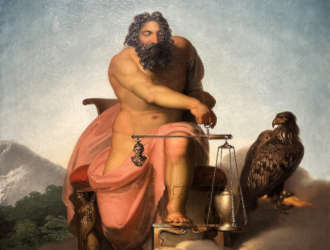 He then regulary traveled to Mount Ida where he watched the war unfold, granting success to Hector and the Trojans which resulted in heavy losses among the Greeks. The tension grew at Olympus and Zeus mocked Hera and Athena that his will cannot be opposed and that more of the same was on the menu until Achilles was forced back into battle. Zeus continued to help Hector with blessings and instructions, protected Sarpedon during his encounter with Ajax and saved Deiphobus and Helenus when they were severely wounded.
Hera urged Poseidon to interviene but he refused, having the power of Zeus in mind. When looking upon the heavy losses in the Greek camp, Hera had enough and deceived her husband in making love to her into exhaustion, in order for him to fall asleep so that they could intervene without him knowing. In the middle of the battle, Zeus woke up and realized he had been deceived by his wife. In his revenge, he ordered Apollo to go to Troy and restore balance, to heal Hector and back up Trojan defenses. With Zeus' Aegis, he strengthened Trojans who then managed to push the Greeks back to their ships.
Later on, when Sarpedon was killed by Patroclus, Zeus sent rain of blood from heaven and sent Apollo to retrieve and cleanse the body and hand it over to Sleep and Death. Another crucial moment happened when Patroclus, a close friend of Achilles, died in a fight with Hector. Achilles was mourning the death of Patroclus and in his sorrow refused to eat. Because of it, Zeus ordered Athena to bring him divine nectar and ambrosia so he could recover.
When Achilles finally returned to battle, Zeus commanded all the gods, nymphs and river gods to assemble on Mount Olympus and then told them to choose a side and support their favorites by directly engaging in battle. After the death of Hector, Zeus orchestrated the retrieval of his body using his influence with Thetis to convince Achilles to let it go and Hermes to instruct and help Priam to retrieve it.
Other myths
It is said, according to Ovid's Metamorphoses, that Zeus and Hermes once visited a village disguised as poor wanderers, seeking food and shelter but were rejected by everyone except the poor couple Baucis and Philemon who kindly offered them food and shelter in their humble home. During the meal the couple realized that the wanderers were divine beings because the wine bowl kept refilling itself. They became frightened and tried to offer a goose that guarded their home as a sacrifice but were stopped by Zeus who told them that village would face judgment for its wickedness.
They were instructed to accompany the gods on a mountaintop where they watched entire village get covered into morass but their cottage was spared. It was then transformed into a temple of marble and gold. Zeus and Hermes offered the couple further reward to fulfill their desire. Instead of wealth and power, they only requested to serve as caretakers of the temple and to die together at the same time. It was granted and, after their death, they were transformed into two intertwined trees standing together before the temple as a sacred memorial.
In another account, when Odysseus and his crew survived the encounter with sea monster Scylla and were completely exhausted, Zeus sent a violent storm with powerful winds that trapped them at the island of Thrinacia, where the sacred cattle of Helios were herded, and delayed their journey. The starving crew slaughtered some of the cattle and prepared for a feast while Odysseus was asleep. When Odysseus woke up he knew that another disaster was imminent.
He was right because Helios, who observed his flock with care, found out about what happened and immediately appealed to Zeus directly, demanding justice and threatening to withdraw his light upon the world and instead go shine down in the underworld. Zeus had no choice but to promise justice and as Odysseus and his crew set sail, Zeus unleashed thunder and lightning, completely shattering the ship in the middle of the sea. All but Odysseus, who refused to feast, were thrown into the sea and died.
Sources
To learn more, you may explore the sources and notes about Zeus yourself