Demeter, goddess of earth and harvest
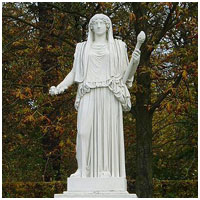 Demeter (Deo, Ceres) was a goddess of earth and harvest. Her greatest gifts to mankind was corn and the knowledge of agricultural techniques. She was also described by Nonnus, Orphic hymn to Ceres and Homeric hymn to Demeter as the Lady of the fruits (of the earth) and according to the latter also as the bringer of seasons. Mostly she was described as a daughter of the titan couple Cronus and Rhea but there are some conflicts among different authors where she was described as a daughter of Cronus and Cybele. However, Gaea, Cybele, Hestia, Rhea, Hera and even Demeter are quite often referred to as the mother earth goddess which is why it comes to misidentifying the correct goddess.
Anyhow, it is known that she resided in most of the mystery cults which were promising the path to a blessed afterlife. She had several children of which Persephone was the most famous and due to her abduction by Hades, and Demeter's search for her daughter, mysteries of Demeter were born. Most famous were Eleusinian Mysteries, the festivals which were held once a year, and the great festivals, held every five years at Eleusis in Ancient Greece where it all began. These festivals were closely connected to the myth of her daughter's abduction and also of great importance, with the basis from an old agrarian cult which goes back to the Mycenaean period.
The ceremony was believed to be the interpretation of the myth in three stages; descent, search and ascent, where the main theme of celebration was the ascent where, in the myth itself, Persephone is reunited with her mother.
Appearance in the works of art
Most of the time, she is depicted as an adult woman, holding a torch in one hand and the cornucopia in the other. The cornucopia was a goat's horn that gave its owner whatever he desired. It symbolized rich harvest or an abundance of food. Sometimes, she is depicted with a golden blade, believed to be from the time of Titanomachy.
Myths of Demeter, her gifts, mysteries, love affairs and more
The following grouped sections are available:
- Gifts to Mankind
- Love affairs and her children
- The abduction of Persephone
- Taking refuge in Eleusis
- Mysteries of Demeter
- Her sacred places
- Other myths
Gifts to Mankind
As mentioned above, Demeter's greatest gift to humanity was corn and agricultural techniques. It is said that she was the first in discovering corn and later shared her secret with Triptolemus while at Eleusis. She is also credited to have taught men how to sow corn, how to plough dirt and how to avoid all the troubles associated with it. According to Hyginus and Orphic hymn to Ceres, she even taught them how to tame oxen in order to help them plough the large amounts of earth later on.
But that was not all, Demeter also instructed laws and obedience to men so that they could become accustomed to deal with one another justly and because of these great blessings to humanity, she was awarded with the most notable honors, generous sacrifices and magnificent feasts and festivals by all men, even barbarians, who had partaken of this kind of food.
Love affairs and her children
The goddess had a few love affairs but only one was due to her willingness. Her only true love was a mortal man by the name of Iasion, a prince of Samothrace. It is said that they made love in a thrice-ploughed fallow in the rich land of Crete but when Zeus heard about this affair, he struck Iasion with a thunderbolt because of jealousy. It was too late though as Demeter got pregnant and gave birth to Plutus and according to Hyginus, who claimed that she had borne two sons, also to Philomelus.
Zeus got his hands on her later and the famous Persephone was conceived but some of the authors are not mentioning Zeus as her father. In Clement's Exhortations, however, Zeus himself was actually a son of Demeter and later had intercourse with her and begat Persephone. Furthermore, Clement also talks about the mysteries of Demeter and that they commemorate the amorous embraces of Zeus with his mother Demeter but, considering that she was by some thought to be the mother goddess, this should come as no surprise.
The goddess was also courted by Poseidon but she refused his advances and transformed herself into a mare and escaped. However, the god of the sea was relentless and tricked her into mating by transforming himself into a beautiful stallion. She later gave birth to a divine horse Arion and, according to Pausanias, to a girl whose surname was 'Mistress' but does not want to reveal her first name to the uninitiated (in mysteries) people. This mistress was believed to be the goddess Desponia. Another lover was Carmanor, a lord of Crete, and from their union Eubuleus was born.
The abduction of Persephone
When Persephone, her beloved daughter, was abducted, Demeter was searching for her in vain. Unable to find her, she in sorrow and anger burned all the fruits of the earth or, in another version of the story, neglected looking after the crops and lands soon became barren. And upon 'Demeter's curse', which caused great drought on lands and consequently famine, it was Hecate who came to Demeter and told her about what she heard. Together they went to Helios who was able to see all deeds from both mortals and immortals. He told Demeter that Zeus and Hades were to blame for the abduction.
The goddess became so mad that she gave ultimatum that the lands would stay barren until she was reuntied with her daughter. Scared of potentially seeing all mortals gone, Zeus intervened and sent Hermes to the underworld to speak to Hades and tried convincing him to let Persephone return back to Olympus.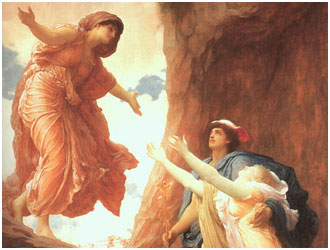 After Hermes' successful persuasion, Hades was willing to let her go but on the other hand tricked her with a honey-sweet pomegranate seed as a farewell gift. As soon as she ate the seed, she became bound to the underworld and would have to return eventually. Demeter was once again outraged but in the end they had come to an agreement that Persephone could stay two-thirds of the time per year with her mother while she had to return to the underworld for one-third of the time. Demeter lifted the curse from the lands but, as a sign of protest, she was casting her sorrow each year when her daughter had to leave for the underworld. This was known as the winter time.
This particular myth is very coveted among ancient authors so the story itself may slightly vary from author to author such as where the abduction took place, where Demeter looked for her, and in details where some authors provide further clues of the events that followed or events that happened before the abduction.
Taking refuge in Eleusis
When Demeter was searching for her daughter Persephone, she took refuge at the palace of Celeus, a king of Eleusis. She took the form of an old woman and asked the king for shelter. Celeus welcomed her in and gave her an assignment to nurse his sons Demophon and Triptolemus. As a token of gratitude in her dark times, she planned to make Demophon immortal by placing him in the flames of the hearth, to burn away his mortal self. It is also said that, while in her care, the boy grew faster than normal and his face became godlike. When the time had come and Demeter wanted to cover the boy in flames, the ritual was interrupted because the boy's mother Metanira came in and started screaming. The flames were put out and immortality attempt was put to an end.
According to Ovid and Hyginus, however, the goddess actually wanted to make immortal Triptolemusm, not Demophon. It is said that later, after the failed immortality attempt, Demeter taught Triptolemus all the divine arts of agriculture. Triptolemus then in return taught anyone wishing to learn. Before Demeter returned to Olympus, she instructed Triptolemus and Celeus on how to celebrate the rites in her temple which soon became known as the Mysteries of Demeter. It is also said that the lesser mysteries were held every year, but the greater mysteries only every five years.
Mysteries of Demeter
As mentioned above, Triptolemus was the first who was initiated into mysteries of Demeter. During the ritual the goddess shared all the secrets about earth's fertility with him. He later spread these secrets to the initiated people and the mysteries became known as Eleusinian mysteries.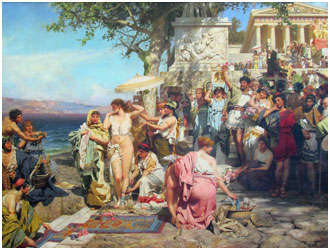 But these were not the only mysteries associated with the goddess. Sabazian and Lernean mysteries and a lot of un-named mysteries were also related to the mysteries of the goddess and there was also the day of Demeter or the day of Ceres mentioned by Fulgentius and Virgil. Similar event was described by Ovid who calls it Games of Ceres and reveals how these were connected to the myth of Persephone and how it was celebrated.
It is said that torches were present on that day as a memorial of Demeter's search for her daughter when she kindled two pine-trees to serve her as light after sunset. It is also said that, because Demeter broke her fast at nightfall after unsuccessful quest of searching for her daughter, the initiates timed their meals at night during ceremony and wore white robes because this was the goddess' proper color, believed to be associated with harvest.
Ovid also mentions that a fox was burned at the festival as a memorial to the incident of a 'vixen fox' which was caught by a young lad and set on fire in retribution for carrying off many farm fowls. But the burning fox escaped his hands and ran into a corn field that caught on fire and all the crops for the incoming winter perished in flames. Therefore, a certain law of Carseoli forbade to name a fox on that day and as the punishment, to the species for destroying crops, a fox was burned.
Her sacred places
There are several places mentioned by the authors that were sacred to Demeter. In Homeric hymn to Demeter it is said that Paros and Antron were sacred to the goddess, while both Ovid and Claudian are mentioning Henna, Sicily. Diodorus Siculus on the other hand reckons that the whole island of Sicily was sacred to Demeter.
There was also an island in Ionian Sea mentioned by Apollonius Rhodius but the author was unsure whether or not it was called Drepane. The island by the ancient name Drepane is now known as island Corfu which is located near Albanian border in Ionian Sea. There was also a river mentioned in Pausanias' Descriptions of Greece that was precious to her. It was called Rheiti. Claudian, on the other hand, even mentions a palace of Demeter which was supposedly built by the Cyclopes but the location remains a mystery.
On top of all the places, the river and the supposed palace, there was also a giant oak tree mentioned, by Callimachus and Ovid, to be very dear to the goddess. It was cut down by disrespectful Erysichthon who was then punished by Demeter. She summoned Famine, who breathed her pestilential poison into his mouth, throat, and chest, spreading the curse of utmost hunger in his veins.
Other myths
While in search of Persephone, Demeter used a spell on her daughter's maids and changed them into Sirens so that they could help in her quest. Originally they were nymphs and daughters of river Acheolus and muse Melpomene.
The goddess was also involved in a myth of Pelops who was killed by Tantalus, cut up into pieces, cooked and served to the gods at the great feast. The gods soon realised what happened and brought Pelops to life again. They assembled his body once again but he was missing an arm. It was Demeter who had previously, before the discovery, eaten it. Therefore, the goddess wanted to make up for it and solved the puzzle by fitting an ivory substitute on his torso. Pelops was alive and complete again and gods satisfied with their just act.
In another myth, Demeter showed anger towards Triopas, a king of Thessaly, who tore down her temple. She brought infinite hunger upon him so that he could not be satisfied by any amount of food and later, when he was already dying, sent a snake to finish the job. He was bitten and died and then placed among stars by the will of the goddess as reminder to others not to mess with her.
Sources
To learn more, you may explore the sources and notes about Demeter yourself