Apollo, god of prophecy, music and poetry
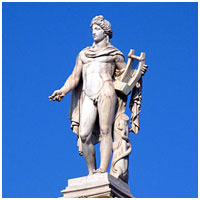 Apollo (Phoebus) was known as a god of archery, music, poetry, healing, prophecy and heavenly oracles, as well as planning and architecture. He was also associated with light and sun and represented the light time of the day, in contrast to her twin sister Artemis. Apollo was friendly and loyal to his family and had high authority among gods on Mount Olympus and beyond, being ranked as Zeus' right hand. Having preference for music, the god was often seen in the company of Muses playing on a lyre or a harp, instruments he considered very dear. Through Muses, being their leader, he would grant people the gift of singing or skills in poetry.
It is said that Apollo discovered archery and introduced healing to mankind, especially the healing of eyes. He was also, by Pan, introduced in the art of prophecy which he absorbed naturally, given his prophetic bloodline, and which he then granted to other gods and favoured mortals.
The god preferred weapons, clothing and instruments made of gold which, along with his youthful appearance, symbolized value, radiance and immortality and it is said that Apollo would only appear to those who embodied greatness. He was also known to act very impulsively when angered, personally bringing sudden death in a cruel way or spreading deadly plagues over entire lands but would try to repent upon realizing a mistake on his part.
Appearance in the works of art
Usually, he was depicted as a young beardless handsome man with long healthy hair, holding a lyre in one hand and a branch of laurel in the other. He was also depicted holding a bow and a quiver of arrows or riding a chariot, being associated with the sun.
Myths of Apollo, his birth, descendants, authority, wraths and gifts
The following grouped sections are available:
- Birth of the Twins
- Authority over the Oracle of Delphi
- His lovers and descendants
- Music contest
- Sacred cities and lands
- Wraths of Apollo
- Trojan war
- Gifts and Transformations
- Other myths
Birth of the twins
Apollo was a son of Zeus and Leto. When Leto became pregnant, and Hera found out about it, the queen goddess and her minions pursued Leto relentlessly, preventing her giving birth, and threatened communities into rejecting the pregnant goddess. She did manage to find refuge on the island of Delos which was believed to be her sister Asteria who had turned herself into an island to escape Zeus' pursuit.
Clinging on an olive tree, Leto first gave birth to Artemis who then helped her mother deliver Apollo which, according to Hesiod's Works and Days, happend on Sunday, the seventh day. Proud of his birthplace, young Apollo used horns as building material and built his own altar at Delos, demonstrating his divine skills of architecture. As for the communities which rejected their mother while in labor, it is said that they were eventually punished by the twins.
Authority over the Oracle of Delphi
It is said that four days after his birth, Apollo traveled to Mount Parnassus to avenge his mother for being pursued by Python during labor. Python was a huge dragon and an offspring of Gaea that used to give oracular responses and guarded the oracle of Delphi.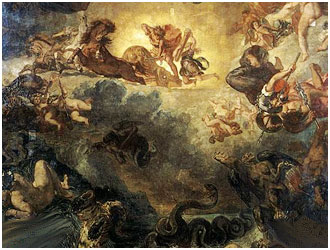 Apollo killed the dragon with bow and arrows, almost emptying the quiver before the dragon collapsed from the wounds. Apollo claimed authority over the oracle of Delphi and instituted Pythian games as a commemoration of this victory and to preserve his glory. Soon after her son's victory, Leto travelled from Delos to Delphi and, when she arrived, she was assaulted by a giant called Tityus who abducted her for his own pleasure. Being dragged by a veil, Leto called upon their children. Apollo, and in some versions of the myth also Artemis, came to rescue and slew the monster with arrows and it is said that Tityus was punished even after death as vultures ate his heart in the underworld.
After successfully establishing the oracle, Apollo, disguised as a dolphin, hijacked a Cretan ship and brought its crew to Delphi. He appointed them as his priests, promising them honor and abundance through offerings.
There were many oracular predictions and instructions given by Apollo, some more important than others. For instance, Cadmus founding the city of Thebes at the location given by the god's oracle and The Epigoni, sons of Argive fallen heroes, waging war on Thebes, after given an oracle to choose Alcmaeon as their leader and make a siege on the city to avenge their fathers.
To purify himself for the murder of Eurytus, Heracles was instructed to submit in servitude for three years. It is said, in Apollodorus' Library, that the oracle was given to Heracles after the conflict with Apollo who opposed and fought the hero for trying to steal the sacred tripod and institute his own oracle to purify disease caused by the murder. They had to be parted with a thunderbolt cast by Zeus. Apollo later prophesied that if Heracles completed all his labors, he would gain immortality.
The god also prophesied the death of Eurytus and disasters for Trojans and Danaans and gave two tripods to Jason for safe voyage because it was decreed by the Fates that the lands would be safe from enemy attack wherever the tripods were placed.
His lovers and descendants
It is said that, proud of his victory against Python, Apollo bragged and made fun of Cupid, dismissing the power of love in comparison to physical strength. Cupid, however, didn't think it was funny at all and struck the god with a golden arrow, inflaming uncontrollable desire for a beautiful nymph Daphne. Apollo was in love for the first time and courted her but Daphne was not interested at all, being struck by Cupid with a lead arrow that repels love. The nymph tried to flee but It was all in vain because the god eventually caught her and forcefully embraced her with his arms. In despair, she prayed to Gaea, asking her to make her disappear. Her request was granted and on the spot, where she was seen for the last time, a sacred laurel tree grew. Disappointed in love and pursuit, Apollo adopted laurel branch as his symbol.
The god was also in love with Coronis and got her pregnant with Asclepius. While he was away, she fell in love with a mortal man Ischys. However, this affair had not gone unnoticed. Apollo left behind a crow to watch over Coronis while he was away and the crow informed him about the affair. Apollo was so outraged at crow, for bringing bad news, that he scorched its feathers and turned the crow black instantly. In anger he also killed Coronis. Later, when Coronis was put on a pyre, Apollo felt sorrow and saved the child from the womb and took him to Chiron.
Alternatively, according to Pausanias' Descriptions of Greece, Coronis was killed by Artemis for the insult done to her brother and it was Hermes who saved Asclepius from her mother's body while she was already aflame.
The god also had his eyes set on Cyrene and abducted her while she was tending a flock of sheep in Haemonia. He took her to Lbya to live among local nymphs near Myrtosian height where she gave birth to Aristaeus. After birth, Apollo transformed Cyrene into a nymph and made her immortal but took his infant son away to be nurtured in the cave of Chiron. The other son of the couple was Idmon, a famous Argonaut seer.
Another famous son of Apollo was Linus, by the muse Calliope, who was killed by Heracles. Then there were also Lapithes, a valiant warrior, and Centaurus, a deformed creature, both sons of Apollo by a water nymph Stilbe, and Syrus, who became the king of Syrians, by Sinope. Apollo carried Syrus away the place where city Sinope was then founded.
The god had many more sons, Dorus, Laodocus and Polypoetes by Phthia, Philammon by Chione or Leucone, Euripides by Cleobula, Ileus by Urea, Lycoreus by a Nympha, Amphithemis and Garamas by Acacallis, Imaus, who received prophetic powers from his father, Oncius, a local leader, Chaeron, a renowned horse-tamer, and Tenerus.
Music contest
After hearing the sound of a lyre and a shepherd's pipe for the first time, Apollo swiftly traded his cattle, the golden wand and the art of prophecy to Hermes in exchange for the instruments, and soon began coveting others, devoting himself to music and poetry. He simply enjoyed music and the company of the Muses. However, Apollo was once challenged by a satyr called Marsyas who found the pipes, or the flute, previously thrown away by Athena. The goddess of wisdom made it from deer bones and threw it away because she was made fun of and called ugly by Hera and Aphrodite. When Athena eventually saw her reflection in the water, her cheeks distorted from playing and her eyes turned grey, she cursed the next bearer of the instrument to be punished severely.
Marsyas kept practicing day after day and soon mastered the instrument. Driven by hubris, he engaged in a musical contest with Apollo. The rules were set that the winner could treat the loser in any way he wanted.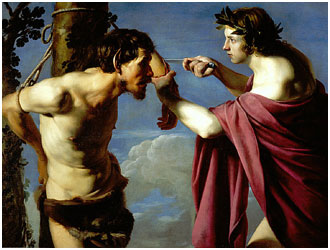 In the first round, the satyr's music was equal to the god's tunes of lyre. Apollo was surprised and bit threatened by the performance of Marsyas and demanded that the second round was played with the instrument turned upside down. The song of the god's lyre was as beautiful as before, while Marsyas got stuck with his 'one-sided' instrument. After losing, Apollo had Marsyas tied to a tree and flayed him to death for his insolence. It is also said that later on the god repented by tearing the strings of his lyre and abandoned music for a while and that from the spilt blood river Marsyas took its name.
Sacred cities and lands
It is said that Delos, Delphi (Pytho) and Lycia were sacred to Apollo who got the names after the lands and became known as Delian, Pythian and Lycian Apollo. He was also known by another name that he got after saving the Argonauts of likely death during the storm. The god descended from heaven with a golden bow so bright that illuminated the surrounding area and revealed an island of Anaphe were they could disembark and rest. On the island, the Argonauts founded an altar of Radiant Apollo.
There was also a mythical place sacred to Apollo where he went when being expelled from heaven after the incident concerning Asclepius. The mythical race were called the Hyperboreans and had a special bond with the god.
In another account, It is said that Battus was once guided by Apollo, in a form of a raven, to Libya where he founded the city of Cyrene which was very dear to the god because of his former love and received more blessings than any other city.
Boeotians and Nisaeans too were commanded by Apollo to build the city around the trunk of an ancient wild olive and worship him as a guardian of all their cities. It was believed that cities under the god's protection were safe from harm, well planned and prosperous.
According to Hyginus' Fables, Apollo is said to have founded the city of Arnae and, according to Pausanias' Descriptions of Greece, together with Heracles also the town of Gythium, after the reconciliation with Heracles over the possession of the sacred tripod.
Wraths of Apollo
There were more occasions where the wrath of the god turned out to be deadly. Once Niobe, a queen of Thebes, insulted Leto, by bragging in front of everyone how blessed she was by having fourteen glorious children and the goddess only had two weird ones. Leto did not take this lightly and sent her children to slaughter all of Niobe's children.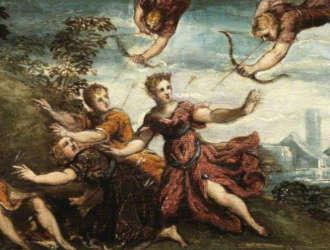 In a matter of seconds Apollo killed seven sons with his arrows, while Artemis killed seven daughters. Alternatively, it is said that she had ten sons and ten daughters and that some survived. In desperation, Niobe escaped to Mount Sypilus, where she was turned to stone by Zeus and formed a rock of continuous tears. Mount Sipylus, nowadays, indeed has a natural rock formation which resembles a female face bowed down and it has been associated with Niobe since ancient times. It is also said that, after the tragedy, Amphion, Niobe's husband, tried to storm Apollo's temple but was killed by the god.
Apollo was very furious at Zeus for killing his son Asclepius with a thunderbolt when the god of healing mastered medicine and helped people cheat death. In revenge, Apollo slaugthered the Cyclopes responsible for creating the thunderbolt and giving it to Zeus. Apollo was then expelled from Olympus and when the judgement took place, he avoided Tartarus through the intervention of Leto. Instead, he was sent in servitude under Admetus. Out of respect, Zeus also placed both the Arrow and the Rod of Asclepius among constellations.
In another account, Laomedon, a king of Troy, also experienced the wrath of god, when he refused to pay for the walls built around the city by Poseidon and Apollo, disguised as mortals. The consequence was fatal as Apollo sent pestilence to the lands and Posiedon the gigantic monster to block the sea and ravage ships.
There was also a priest of Apollo by the name of Laocoon who married and had children against the god's will. Apollo sent serpents to kill him and his children as retribution. The god is also said to have killed Linus, the son of the muse Urania, because of rivaling him in musical reputation.
Trojan war
During the war, Apollo supported Trojans, mostly because at the very beginning Agamemnon captured a nymph and god's priestess Chryseis and refused to return her to her father. In anger, Apollo sent plague into encampment, spreading disease among Greek troops. Agamemnon then had no choice but to return Chryseis, to prevent further wrath from the god. After she was safely returned, Apollo lifted the plague and sent favourable winds, cancelling the storm conjured by Artemis who was also angry at Agamemnon. Since the gods weren't allowed to interfere directly, Apollo acted as a protector, healer and strategist, motivating troops and protecting heroes.
It is said that he protected Aeneas from Diomedes and removed Aeneas from the battlefield when injured and had him healed by Leto and Artemis in his temple. Meanwhile, he planted an illusion of Aeneas on the battlefield to keep the momentum going. Apollo then urged Ares, who was slaughtering Greek soldiers in bloodlust and defiance of Zeus' directive, to confront Diomedes and later returned the Aeneas, after he was healed, to the battlefield.
The god also repeatedly protected Hector from encounters with Diomedes, Ajax and Teucer, deflecting incoming attacks and reviving him in key moments, even provided him the divine aegis and helped him lead an assault to drive the Greeks back to their ships. Glaucus and Sarpedon were also rescued by Apollo who played a key role in Hector's victory against Patroclus. When Achilles killed Hector and was dragging his body for days, Apollo shielded the body from harm, preserving it until safely returned to Priam. In some versions of the myth, Apollo was angered by Achilles' arrogance and helped Paris, a prince of Troy, killing Achilles by guiding the arrow to the hero's vulnerable heel.
When the gods were allowed to support their favourites and engage in the battlefield, Poseidon prompted Apollo to fight him but Apollo refused, letting him know that no human was worth fighting for with another god. Instead, It is said that after the war, Apollo and Poseidon destroyed the Achaeans’ wall by unleashing rivers, rain, and floods, erasing all traces of it.
Gifts and transformations
When Apollo served under Admetus and herded the king's cattle out of love for pasturing, they became friends and the god helped him win the hand of Alcestis. They were happy in marriage and Admetus started to neglect his duties. It is said that he forgot to sacrifice to Artemis and the goddess in revenge planted serpents in his marriage chamber. The king was struck by the serpents and started fading away. Apollo tried to save him but the Fates had other plans. The god did manage to negotiate a deal with the Fates that Admetus would be released from certain death, if someone else died instead. In the end it was no other than his wife Alcestis who sacrificed herself and died. However, it is said that Persephone or, alternatively, Heracles brought her back from the underworld to be reunited with her husband.
Once Apollo fell in love with a mortal woman and a maiden called Bolina. To escape his advances, she fled and threw herself into the sea but was granted immortality by the god. The city of Bolina and the river Bolinaeus got the name after her.
In another account, King Nestor was granted an extended lifespan by Apollo in exchange for the years taken from his mother Chloris and her siblings. The god also gave the gift of prophecy to Phineus, after he was wrongly blinded by his father for the charges brought up by his mother against the father. Apollo also taught Pandarus everything about archery and gave Heracles a bow and arrows.
After the death of Chione, her father grieved in so much pain that Apollo felt pity and transformed him a hawk. The god also once transformed a musician by the name of Swan into a swan after passing away and an unknown man into a sea-calf.
Other myths
During Gigantomachy or the War of the Giants, Apollo blinded the left eye of Ephialtes with an arrow while Heracles did the same to the giant's right eye. However, later on when Typhoeus attacked heaven, Apollo fled to Egypt with the rest of the gods, except Zeus, and transformed into a crow.
The god was also said to have abandoned his duties at the oracle of Delphi to hang out with Hyacinthus, a mortal youth that he favored. Wanting to impress Hyacinthus, Apollo threw the discus with all of his force and accidentally killed the young man who wanted to catch it. Alternatively, it was the wind Zephyrus, being angry at Apollo, who changed direction of the discus that killed him. Despite his mastery in healing, Apollo was unable to save him. He felt responsible and, through his grief, he created a hyacinth flower from the youth's blood. He inscribed 'AI, AI', a cry of mourning.
Accoridng to Hyginus' Astronomica, the crow was condemned to eternal thirst by Apollo for being late in bringing him water. The god placed Crow, Bowl and Water-snake among constellations in such fashion to illustrate the thirst of the crow.
Sources
to Hestia, to Muses and Apollo
To learn more, you may explore the sources and notes about Apollo yourself