Heracles, the most powerful hero
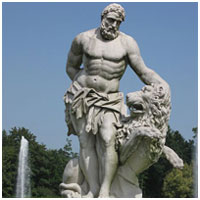 Heracles (Hercules) was the most powerful and the most famous hero of all time. He was known for his exceptional strength, even surpassing many gods, as well as for his courage, his appetite for wine, food and sexuality with both women and men. It was also believed that despite his ingenuousness in several of his quests, he lacked a fair amount of intelligence. He was very passionate, short-tempered and emotional individual, although many comic playwrights described him as primitive, brutal and violent in their games. Heracles was the kind of person who would often get into trouble but was then also determined to resolve the issues and make things right.
Actually, many of his good deeds came from solving his trouble. The most famous of these are the twelve labours. After completing more deeds than anyone else which gained him favors of the gods, Heracles eventually ascended to Mount Olympus upon his death in the mortal world.
Appearance in the works of art
Usually, Heracles is depicted as a muscular grown man with a beard, holding a massive club in his hand. On some occasions, he is also wearing a lion skin garment with lion's head still attached, serving him as some sort of hood.
Myths of Heracles, his early life, the Curse and the Twelve Labors
The following grouped sections are available:
- Early life of Heracles
- The Revenge of Hera
- The Twelve labors of Heracles
- More deeds before Ascension
Early life of Heracles
Heracles was a son of Zeus and mortal woman Alcmene. Zeus tricked Alcmene by turning himself into Amphitryon, who was with her at the time, and slept with her. She became pregnant with twins from both, the god and her man. Heracles and his mortal twin brother Iphicles were born at the palace of his stepfather in Thebes. Upon Heracles' birth, Alcmene feared that he would be persecuted by jealous Hera and therefore abandoned him in the fields. Soon Athena found the child crying in the fields and took him to Hera who wanted to nurse him with her breast. But the child caused her pain and she threw him on the ground.
Athena then took Heracles to Alcmene on Zeus' advice. Alcmene recognised her child and was joyful to accept him.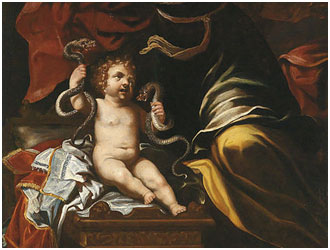 However, finding the truth behind all of this, Hera became filled with rage and sent two serpents to crawl into the chambers where the baby was sleeping. He woke up crying and grasping a snake in each hand. In the moment of heat, he strangled them with his bare hands. It was then, when Amphitryon realised that he had been blessed by the gods for giving him a son with great destiny. Instead of ordinary lessons, he rather taught him how to ride a chariot while Alcmene arranged study lessons with Rhadamanthys to improve his knowledge. The brothers were also learning music from Linus, a son of Apollo and Urania, who was also an inventor of rhythm and melody.
However, this didn't end well as Heracles eventually killed Linus with his own lyre in one of the lessons, after being repeatedly reprimanded for making errors. Heracles, not the brightest one, rather wielded physical power instead of knowledge and therefore his path led him to Autolycus who taught him the art of wrestling and Castor who taught him how to use armour and weapons.
The Revenge of Hera
He was still young and learning but his first public recognition came soon enough. He drove off and defeated the Minyans who sieged Thebes and were demanding a tribute. As a reward, the king of Thebes granted him one of his daughters. They got married and had up to eight children, variously, according to different sources. Hera saw the opportunity to finally get her revenge, to hurt his family, if she couldn't hurt him. She cast a spell of madness on Heracles, forcing him to kill his wife and children.
When Heracles came to his senses and realized what he had done, he wanted to take his life. However, he was saved and persuaded by Theseus and joined him to live in Athens. When the worst was over, he travelled to the Oracle of Delphi for guidance. The oracle told him that there was still salvation for his soul and he could purify it by serving his cousin Eurystheus, a king of Mycenae. The King, who was under the influence of Hera, gave him twelve "impossible" quests to complete.
The Twelve labors of Heracles
According to general belief, the labours were set in the next order. However, this order and the content itself may vary due to different sources. It is also said that he was originally given ten tasks, but was additionally added two more because in one task he accepted payment for it, while in the other he was getting help from his nephew Iolaus.
Heracles was first tasked to kill the lion which harassed the lands of Nemea, near Mycenae. The beast was not an ordinary beast but was an offspring of the mighty Typhoeus, the last descendant of Gaea. Heracles unsuccessfully tried to hurt it with bow and arrows and also with his club but the beast's skin was just too thick. After realising this, he then wrestled with the beast, managed to wrap the hands around its neck and strangled it. After defeating the beast, he wanted to remove its skin for evidence but was again unsuccessful in his attempts. Heracles became anxious, contemplating that he would't even make it in his first quest and already had first thoughts of withdrawing from the task.
However, Athena came to rescue in the guise of an old crone and helped him realise that the best tools to cut the hide were the creature’s own claws, thus allowing him to complete the task. Heracles then returned to Mycenae and presented the lion skin to Eurystheus. The king was surprised and terrified of the hero's power and demanded that from that moment Heracles was forbidden to enter the castle and had to present all of his evidence outside city walls. It is said that Heracles kept the skin and has worn it forever since.
His next task was to kill the Lernean Hydra, a ferocious monster with multiple heads. The beast was set there intentionally by Hera to slay the hero. Heracles took his nephew with him this time.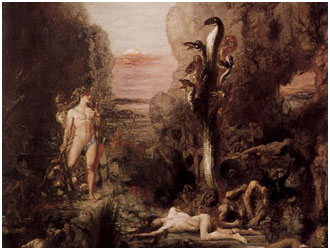 When they arrived at the lake Lerna, Heracles instructed Iolaus to wait by the chariot outside, while he was going into the lair and deal with the monster. He went to the entrance and fired several fire arrows into the lair, to lure the monster out. The beast came out and it was all going according to plan, until he chopped off one of the beast's heads. To his surprise, the head grew back (two heads according to some sources). Heracles was pressured by the monster which was trying to poison him with its breath. He was forced to call Iolaus for help and they came up with an idea to scorch the neck of each head, after being decapitated.
The plan worked and the monster was left with only the one immortal head which couldn't be harmed. Heracles stunned the beast's head with his club and, while it was unconscious, they buried the beast deep in the ground and placed large rocks on top. When they returned to the city walls, Eurystheus learned of his nephew's help and declared the labor incomplete because of the aid. The labor did not count towards the ten labors set for him.
After slaying the lion and hydra, Hera and Eurystheus changed tactics and instead of killing a beast, Heracles had to capture the Ceryneian Hind, a female deer which was the fastest of all deers and sacred to goddess Artemis. It took over a year for Heracles to hunt down the deer that was chased by the hero over all Greece. Upon returning with a live deer on his back, Heracles encountered angered Artemis and her brother Apollo. Knowing the wrathful nature of the goddess, he begged her for forgiveness and promised to return the deer unharmed after completing his task. Artemis accepted his request and Heracles got away with it and completed the task successfully.
After completing the third task, he was once again set to capture a live animal. This time, it was a enormous boar which had a lair on Mount Erymanthos. On way to the mountain, Heracles encountered his old friend Pholus, a kind and hospitable centaur who invited him for a meal inside his cavern. After eating the meat raw, Heracles desired wine.
Pholus couldn't say no but warned Heracles not to open the jar, because it was a gift from Dionysus to all centaurs. Heracles opened it anyway and attracted other centaurs into the cave. They weren't fond of a man drinking their wine and attacked Heracles who wrestled them until setting himself free for a brief moment. The hero took his bow and shot them with arrows, dipped into the venomous blood of the Hydra. Many of the centaurs died and the rest scattered in their escape from Heracles' rage.
Meanwhile, Pholus was being curious why so many centaurs died with so few arrows. While picking up the arrows one slipped from his hand and stabbed him in his foot, poisoning him. He soon perished from the poisonous venom. When Heracles came back he realised what happened and mourned. Now more than ever, he was determined to complete the task and tasks to follow. He soon located the boar and skillfully led it into deep snow, preventing the beast from moving normally. He then bound it with ropes and carried it back to the walls of Mycenae to show his trophy.
Despite Eurystheus being afraid of Heracles and the beast that he has brought with him, which made him hide in a big bronze jar, this actually pleased him in a certain way because he already had a new plan to humiliate his cousin and made it impossible to accomplish at the same time. He ordered Heracles to clean up the Augean stables in a single day.
King Augeas owned more cattle than anyone in Greece and the stables hadn't been cleaned once in thirty years. Heracles approached Augeas and made him an offer. He demanded ten percent of his cattle, if he was able to clean the stables in a single day. Augeas, laughably, accepted the offer and his son was the witness. Heracles then completed the job by making tunnels from the stables to the nearby rivers and diverted the flow from one river through stables and to the other river. The river flow cleaned the stables and Heracles completed his task smoothly and without getting dirty.
However, Augeas didn't want to pay when he found out that it was Eurystheus behind all of this. He even denied ever promising to pay any reward. But, when this case was brought to court, the judges finalized their decision that Augeas has to pay Heracles. The decision was influenced by Augeas's son who swore and told the truth about his father promising the reward. Consequently, Augeas banished both, the hero and his own son, from his lands. When Heracles came back to the city walls, Eurystheus claimed that the task didn't count because Heracles got paid for it. And seven tasks still remained.
In the next task, Heracles was ordered to defeat the Stymphalian birds, the men eating birds with sharp metallic feathers and beaks of bronze. On top of all, their dungs were toxic and very dangerous when multiple specimens had the urge to drop it at the same time.
Heracles then travelled to the Lake Stymphalia in Arcadia where the creatures of Ares were gathering and breeding.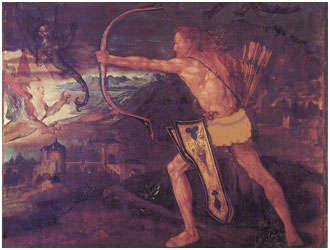 But he couldn't get far because the swamp was pulling him in. He went back to reconsider his plan. While going through his ideas, Athena descended and gave him a rattle which was specially made by Hephaestus for this task. Heracles searched the area for a good spot. When he found it and prepared himself, he shook the rattle. All the birds flew into the air with a simple goal of escaping. Many were shot down by the powerful shots of Heracles that pierced through metallic feathers and hurt them. The rest of them fled and never returned again. The special rattle worked and the task was completed.
For his seventh task, he was sent to Crete to capture a bull for Eurystheus' own purposes who wanted to sacrifice the animal to Hera. When Heracles arrived to Crete, he was given permission by Minos, a king of Crete, to take away a bull. However, task was not done yet, as Heracles needed to control the animal which he was able to do, without any problems. He shipped it to Mycenae, where Eurystheus tried to sacrifice the animal to Hera. Before the sacrificial ceremony, Hera descended and claimed that she would not accept an animal from Eurystheus because it reflected glory on Heracles. And without any further purpose, Eurystheus let the bull wander into Marathon and it later became known as the Marathonian bull. Unfortunately for the King, Eurystheus had to acknowledge the task as completed and gave Heracles next one.
The king sent Heracles to steal the man eating mares of Diomedes. He travelled with volunteers to Bistonia, where the horses were kept. They easily overcame the resistance and took the horses. However, they were not aware that the horses were wild and had uncontrollable appetite for human flesh. It took a lot of determination to control them on their way back. On top of everything, Diomedes and his followers were right behind and soon caught up with them. Heracles and his companions had to battle Diomedes and his followers who wanted to re-claim the mares.
In the meantime, a young man by the name Abderus was entrusted to look out for the horses while they were fighting. When Heracles came back from the fight victorious, killing Diomedes and his men, Abderus was dead, eaten by mares. In the fury, he dragged Diomedes' body and fed it to horses. After all of the blood spilt, he buried Abderus and honored him with founding a new city called Abdera. The horses were in the end forcefully, with their mouths bound, brought to Eurystheus by the hero. The king wanted the horses to be brought to Olympus and sacrificed to Zeus but the King of the Gods rejected the sacrifice and sent his own animals (lions, bears, wolves) to kill them.
Eurystheus wanted to please his daughter Admete who wanted the magical leather belt of Hippolyta, a queen of Amazons, who had been granted the belt from Ares as a token of their warrior oriented life and supreme fighting skills. The king sent Heracles into action again. Heracles knew that he wouldn't be able to defeat the entire amazon army himself and took his band of followers with him, including Theseus who volunteered for this quest. In their journey, Heracles lost and replaced some of his men before finally reaching the island of Amazons.
Upon their first meeting with the Amazons, Heracles told the true reason for coming to the island. Hippolyta was impressed with his honesty, and his physical appearance, and planned to give him the girdle without proving himself. However, Hera ruined the plan, disguising herself into an amazon and seeding mistrust among them. She claimed that the strangers had a hidden agenda and wanted to kill the queen.
Amazons put their armor on and confronted Heracles and the crew who fought back. In the end, after many amazons and warriors fell, Theseus kidnapped Hippolyta and delivered the belt to Heracles who then successfully brought it back to Eurystheus.
In his tenth quest, Heracles travelled to the far western Mediterranean island of Erytheia, in order to obtain the cattle of Geryon. During his travel through Libyan desert, he became desperate and in anger shot an arrow at Helios, a Titan god of sun. Impressed by his courageous act, Helios gave Heracles the golden cup which he used to get to Erytheia. Once there, in his first steps the hero encountered Orthrus, the two-headed beast, which immediately attacked him with a plan to end his life. Well, the life has ended, but for the beast when the hero smashed it with his olive club.
All these noises interrupted Geryon, the three bodied and four winged giant, who went into action, carrying three shields and three spears, wearing three helmets and three pair of leggings. He managed to put pressure on Heracles and drove him all the way to the river Anthemus where he eventually died from the shot of Heracles. The hero dealt a deadly wound into the giant's forehead with a poisonous arrow, dipped into hydra's blood. He then claimed the cattle but more than a year had passed before Heracles finally brought the herd before Eurystheus.
It would take less time for Heracles to bring them back but the hero had a few setbacks because of vengeful Hera. She sent a gadfly to scatter the flock and forced Heracles to find each and every one of them. When finally got them all together, the angry goddess sent a flood which raised the level of a river so much that the hero could not cross with the cattle. He had to pile stones into the river to make the water shallower. In the end, Eurystheus approved the task as completed and started plotting a new one.
Heracles was next tasked what was believed to be impossible to accomplish by the king Eurystheus. He sent the hero for some of the golden apples from Hera's garden. The garden was tended by Hesperides and watched by a minion of Hera, the one hundred-eyed snake. After making enquiries how to solve the quest, Heracles was directed to Mount Caucasus in order to ask someone of the older ages where the garden might be located. That someone happened to be Prometheus chained on a rock. They agreed to exchange services and Heracles was supposed to free Prometheus, after the titan would tell him the location of the garden. Heracles then shot the giant eagle with his hydra poisonous arrow and released Prometheus as promised. Grateful Prometheus, finally released out of the torment, advised Heracles that the best chance of getting the apples was to send his brother Atlas.
The hero took notes and searched for Atlas in the depths of the west and found him carrying the heavens on his shoulders. In need of his services, Heracles offered himself as temporary caretaker.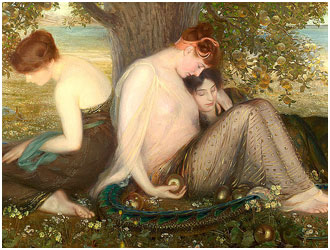 In return, he asked Atlas to help him get some of the golden apples. The garden, controlled by Hera, was tended by Hesperides, the daughters of Atlas. Upon return, Atlas tried to convince Heracles to hold the heavens a little bit longer while he was going to deliver the Apples himself which was definitely not the case. Heracles thought of this and asked him to hold the heavens just for a few moments, so he could re-position his cloak to serve him as support. Atlas fell for the trick and, when he reclaimed his position, Heracles took the apples and ran to deliver them to Eurystheus. The king was furious, when he was the witness of Heracles' successful return with the apples and with the help of Hera forged the final doom quest for the hero.
His final quest was to travel to the underworld and capture Cerberus alive and bring him back. Heracles went to Eleusis to be initiated into the Eleusinian Mysteries where he could learn how to enter and exit the underworld alive and in passing absolve himself for killing centaurs in one of his previous quests. He found the entrance to the underworld at Tanaerum, where Athena and Hermes helped him traverse the entrance in each direction. While down in the pit, he freed Theseus who was trapped there for trying to kidnap Persephone.
When Heracles finally reached Hades, he asked the god for permission to take away Cerberus from the underworld. Hades agreed on one condition which was to overpower the beast with bare hands. The hero was able to manage the beast, tie it up and sling it over his back. He was dragging it all the way back from the underworld to the walls of Mycenae. When Eurystheus saw the beast, he cowardly jumped into his bronze jar and sent a messenger with his orders to the walls. His offer was to release Heracles from his labors, should he took the monster back to the underworld.
More deeds before Ascension
When finished these twelve treacherous tasks and finally redeemed his soul, Heracles didn't just sit back and rest on his laurels. He had many more adventures. One was to rescue the princess of Troy for a ransom from the hungry sea-monster, sent by Poseidon. Another quest was to help Zeus defeat the Giants in a great battle for the control of Olympus. He also joined Jason and the Argonauts on their way to Colchis, but was left behind after refusing to move on upon losing his friend Hylas.
According to some sources, Heracles eventually ascended to heaven upon his death. It is said that the centaur Nessus was responsible for the hero's death. When he kidnapped Deianeira, a wife of Heracles, the hero came for her and in retribution dealt a deadly wound to the centaur. When Nessus was dying he told Deianeira that his blood would ensure Heracles' devotion to her for eternity. But, instead, it poisoned and killed Heracles who was then taken to Mount Olympus by Zeus.