Achilles, great hero of the Trojan war
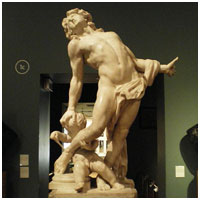 Achilles (Akhilleus) was a hero of great power, celebrated for his exceptional skill in hand-to-hand combat. He was also credited with being a master of weaponry, particularly with swords and spears. Achilles was a son of goddess Thetis who tried to make him immortal by dipping him into river Styx or, according to other sources, by burning out his mortality. His destiny was to become the greatest hero of the Trojan war, but also to die there. He was really a great warrior and his moves in combat seemed supernatural. Because of that, he influenced and inspired the rest of his fellow Greek warriors.
Olympian god Hephaestus made him a complete armour, a shield and a spear on his mother's request. His divine armour included greaves, helm, body armour and gauntlets which have only enhanced his supposed immortality.
Appearance in the works of art
He is usually depicted as a grown man wearing his divine armour, holding a shield and a spear. There are also quite a few artworks of his childhood, such as training with Chiron, the famous centaur, and him being dipped into river Styx by his mother Thetis.
Myths of Achilles, his gift, childhood and Trojan war
The following grouped sections are available:
The Immortality Gift at Birth
Achilles was a son of nymph Thetis, a daughter of sea-god Nereus, and Peleus, a king of Myrmidons. Thetis was courted by Zeus and Poseidon before she finally became a consort of Peleus. The reason for the gods withdrawing from their pursuit of the goddess was the prophecy of Prometheus who claimed that the child would become more powerful than his father. When Achilles was born, his mother brought him to the river Styx which separated the land of the living and the land of the dead. It was believed that everything the river touched became invulnerable. Thetis wanted to make Achilles immortal by sinking him into the river, but made one mistake. When she was bathing him in the river, she was holding him by his left ankle which was left dry and, because of it, unprotected.
Life before the war
When he was reaching boyhood, he was sent by his father Peleus to Mount Pelion to be taught by centaur Chiron who taught him all about surviving, hunting and warfare. When still at his young age, seer Calchas prophesied that the Greeks would not be able to conquer the city of Troy without the help of Achilles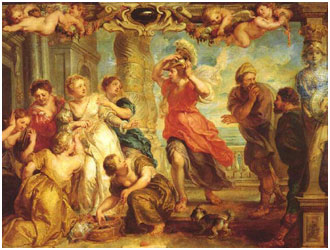 and if he joined the war, he would die. Because of this prophecy, his mother Thetis had no choice, in her mind, but to protect her son from ever entering the lands of Troy and, consequently, early death. Therefore, she sent him to Scyros where he was hidden away and disguised as a girl. But his cover was soon blown by Odysseus who placed an armour and weapons among girly things. It turned out that Achilles was the only one interested in armour and weapons and not at all interested in girls clothing. With his cover blown, Achilles agreed to travel to Troy with Odysseus and lead an army of his father's people, the Myrmidons, into battle.
Trojan war
Upon his arrival to Trojan lands, Achilles quickly proved himself in battle. Together, the Greeks easily overcame many towns. In one town in particular, the story gets a twist. At the town of Lyrnessos, he took the woman called Briseis as his personal reward. He quickly fell under her charms and showed a certain lack of interest in the battle.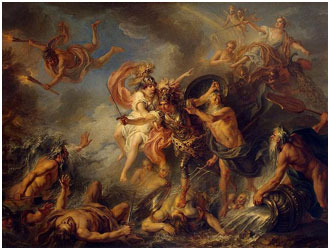 To make the things even worse, king Agamemnon took Briseis from Achilles upon losing his prize Chryseis to Apollo when the god demanded from the king to return his beloved priestess. Achilles was furious and refused to fight and, because of it, the war turned in Trojan favour. The Greeks unsuccessfully begged him to return to battle but his best friend Patroclus thought that he found a solution. He knew that he won't be able to convince him and the troops morale was already on the edge. Therefore, he asked Achilles to lend him his armour in order for him to raise the morale of the Greeks while in disguise, pretending to be Achilles, and led them into victorious battle.
However, Patroclus was killed the very next day by Hector who thought that he had slain Achilles and took the body with armour still on. When Achilles found out about this he became filled with rage and returned to battle in his new armour, made by Hephaestus. He avenged his friend by killing Hector but, still being furious, he tainted his glorious victory by dishonorably dragging Hector's body behind his chariot in front of the gates of Troy for everyone to see.
Achilles refused to give the body to Trojans and allow them to have a proper funeral. Instead, he took the body to his camp and placed it on a stick as a display of his fury. That night Priam, a king of Troy, secretly sneaked into the camp and begged him to give back the remains of their hero. Achilles finally felt pity and showed respect by agreeing to return the body.
The Death of Achilles
The war went on and Achilles had slain many opponents including Memnon and the amazon warrior Penthesilea. He continued to fight bravely until Paris, a prince of Troy, guided by Apollo himself, wounded him with an arrow to his heel. The wound was critical because Achilles died from it. After his death, Odysseus got his divine armour after winning in a competition with Ajax.