Perseus, the slayer of Medusa and Ethiopian Cetus
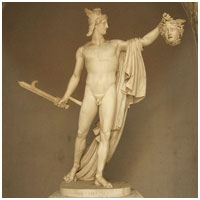 Perseus was considered as one of the most famous and popular heroes in Greek culture. He was known for his vigorous strength, incredible bravery and slaying two of the most ferocious monsters, known as Medusa, the youngest of the Gorgons, and Ethiopian Cetus, the sea monster of Poseidon. He was favoured by the gods because, in his quest to defeat Medusa, he was given a lot of equipment by various gods which helped him to defeat the vicious monster. Perseus was also thought to be a very good son, helping his mother to adjust to her new island and keeping her away from a greedy king Polydectes.
At his old age, he was an honorable king and a good husband to Andromeda who he rescued from the sea monster. After the death of his grandfather, Perseus and Andromeda travelled to Tiryns. Once settled there, Perseus went to found the city of Mycenae in the nearby lands.
Appearance in the works of art
Most of the time, Perseus is depicted as a young man, wearing a winged helm, holding a sword in one hand and Medusa's head in the other. Or he is just depicted without a sword, only holding the head of Medusa in his hand. Some of the works are linking him to the Medusa quest, others to the quest of rescuing Andromeda. Few works even depict him in his encounter with Atlas.
Myths of Perseus, his Birth, Quests and the founding of Mycenae
The following grouped sections are available:
- The Epic birth of Perseus
- The Quest of slaying Medusa
- Meeting Atlas
- Defeating Ethiopian Cetus
- Marrying Andromeda and rescuing his mother
- Founding Mycenae
The Epic birth of Perseus
The myth begins when the oracle of Delphi prophesied Acrisius, a king of Argos, that his grandson would take his life. As a result, the fearful king decided to lock his own daughter Danae in a courtyard bronze chamber, in order to prevent her from having contact with any man. However, this chamber was open to the sky which enabled Zeus to observe this helpless girl from Olympus and fell in love with her. And so Zeus came in the form of golden shower and impregnated her.
Danae gave birth to a son and named him Perseus. The baby's cries had not gone unnoticed and the furious king wanted to kill them both, but was fearful to provoke the gods and cast them into the open sea in a closed wooden chest. When Zeus saw what happened he asked his brother Poseidon to calm the sea and the chest was carried to the island of Seriphos, where a fisherman Dictys found it and took Danae and Perseus to his home. The fisherman helped Perseus to become a healthy youth, teaching him all about fishing and life.
The Quest of slaying Medusa
After Perseus was reaching manhood, things got complicated when the King Polydectes, a brother of Dictys, fell in love with Danae and wanted to marry her. After unsuccessful courting and consecutive denial by Danae, Polydectes thought that Perseus was the main obstacle for their marriage. The king therefore sent Perseus on a quest to bring the head of Medusa, thinking it would be his doom. Medusa was once a beautiful maiden with stunning hair who had sexual intercourse with Poseidon in the temple of Athena.
In revenge for the desecration of her temple, Athena turned her hair into living snakes. Perseus was favoured by the gods and Athena instructed him to find Hesperides who were entrusted with the item needed to defeat the Gorgon. The hero first had to find Graeae, the three old women, who shared a single eye, in order to convince them to reveal the Hesperides whereabouts. As the women passed the eye from one to another, with the intention of taking a closer look at the handsome young man, Perseus snatched it from them and was holding it for a ransom in return for the location of the Hesperides. This being their only way to see things, they had no choice but tell him about the location.
Later, when the hero finally found Atlas' daughters, they gave him Kibisis, the only sack able to contain the head of Medusa. To increase his chances of defeating the monster, Zeus gave him a curved sword and Hades' helm of darkness.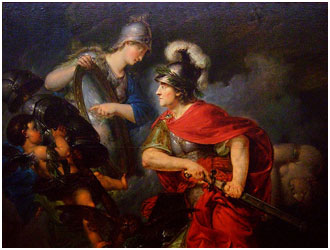 Hermes lent him a pair of winged sandals, while Athena gave him a polished bronze shield, to serve him as a reflection to be able to see Medusa indirectly and not get turned into stone. Perseus, fully equipped with divine items, proceeded to the lair of Medusa which was believed to be somewhere in the lands of present Libya. He had flown silently into the cave and put on the helm of darkness which made him invisible. He surprised Medusa who was unable to detect approaching danger. With the help of the reflection of his shield, he chopped off her head with his sword and killed the monster.
It is said, by some authors, that Pegasus, a winged horse, and Chryasor, a giant, were born from her spilt blood and are crediting Poseidon as their father, because of the incident they had in Athena's temple.
Meeting Atlas
On his way back to Seriphos Island, he encountered the titan Atlas with heavens on his back. In their confrontation, where Perseus asked the titan for a shelter, telling him that he was a son of Zeus, Atlas replied by stating that he was a liar which angered the hero. As a result of the argument, Perseus turned the Titan to stone, now known as Mount Atlas.
Defeating Ethiopian Cetus
The next day, when he was about to resume his travel back to Greece, the news about sea monster and sacrificing Ethiopian princess came across to Perseus. He decided to help and travelled to the mentioned Ethiopian shore. When he came there, he noticed Andromeda, the Ethiopian princess, chained to a rock, waiting to be sacrificed to the sea monster. The reason behind all of this was her mother's ego, when she bragged that her daughter is more beautiful than the Nereids, sea nymphs.
The word spread and nymphs, relatives of Poseidon, complained to their ruler. The god of the sea then sent one of his minions to seek retribution.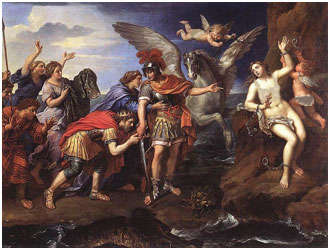 Cetus, the giant sea monster, constantly ravaged the coastal lands of Ethiopia, causing many deaths and preventing any trade routes over the sea. King Cepheus then sought help from the oracle of Delphi where he was told that the only way to satisfy Poseidon would be to sacrifice Andromeda to the monster. When the princess was approached by the monster, Perseus descended from the sky to take a closer look at her. Overwhelmed by her beauty, Perseus immediately fell in love and was even more determined to kill the monster that had just interrupted their first conversation. He overcame the monster and released the princess from chains.
Marrying Andromeda and rescuing his mother
Perseus then took her to her father and asked for her hand in marriage. This angered Andromeda's uncle Phineus whom the maiden was already promised to. During the arising quarrel, Perseus turned Phineus to stone by showing him the head of Medusa. In fear of the hero, the father of Andromeda agreed and they got married. The newly married couple returned to island of Seriphos where Perseus found his mother Danae who was still being pursued by Polydectes. Without hesitation, he kindly showed him the head of Medusa and added another statue to his trophies. Perseus then made his caretaker Dictys the new king of Seriphos as a token of gratitude. He also returned divine items to the gods and gave away the head of Medusa to Athena.
Founding Mycenae
Making things right on the Seriphos island, Perseus then travelled back to Argos, accompanied by his bride and his mother. When they finally settled there, he accidentally killed his grandfather in a sports competition by misthrowing discus and fulfilled the prophecy that was given to Acrisius. After the death of Acrisius, the Kingdom of Argos naturally passed on to Perseus but he thought himself unworthy because of the accident.
Consequently, Perseus gave away the kingdom of Argos to Megapenthes, in exchange for Megapenthes' kingdom of Tiryns. Perseus and Andromeda eventually settled in their new kingdom and had seven sons and one daughter. Later Perseus founded the nearby city of Mycenae which became the most powerful city of Peloponnese in the Mycenaean times.