Athena, goddess of wisdom, strategy and skill
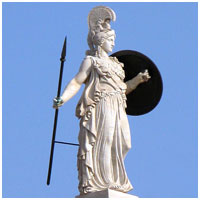 Athena (Tritogenea, Minerva) was a goddess of wisdom, strategy, warfare and skill. She was also known as the guardian of civilization and bringer of inspiration. She was skilled in various crafts, especially metalwork of weapons and weaving, being the first to introduce cloth making and carpentry. Her greatest gift to mankind, however, was the domestication of the olive tree and the knowledge how to cultivate it and how to use olives in many different ways. Athena was strong and wise as Zeus and tried to serve justice like her father. She pledged herself to maidenhood and, instead of romantic endeavours, completely focused on her duties as a goddess.
She was calm, compassionate and caring because she was ready to help anyone in desperate times, but could also be proud and unforgiving to those who she thought deserved such punishment.
Her intelligence, courage and expertise in warfare strategies and discipline led to successful victories without too many casualties. Just the opposite of Ares who represented violence and destruction and led his disciples to the raw force of war, causing total devastation. Athena was also a patroness of Athens and the Parthenon on the acropolis of Athens was built in her honour.
Appearance in the works of art
Most of the time, she was depicted as a bright-eyed woman in combat armor, wearing a helm and holding a shield, the famous aegis given to her by Zeus, in one hand and a spear in the other. At times, she was also depicted with an owl on her shoulder, it was her symbol and a sacred animal that was under her protection.
Myths of Athena, her life, relationships, battles and more
The following grouped sections are available:
- The birth of Athena
- Becoming patroness of Athens
- Awkward relationship with Hephaestus
- Gigantomachy
- Trojan war
- Helping heroes in their quests
- Notable transformations
- Other myths
The birth of Athena
Athena was a daughter of Zeus and goddess Metis. It all started when Zeus fell in love and started pursuing Metis with extreme determination. She tried to avoid him and took many different shapes but to no avail because Zeus managed to track her down and embrace her, getting her pregnant. Metis was finally at ease for a while until Zeus heard the prophecy from Gaea that, after giving birth to a maiden first, Metis would bring forth a powerful son, the next king of heaven and ruler of the Cosmos.
Out of fear, just like his father Cronus had done it in the past, Zeus swallowed Metis to prevent the child from being born.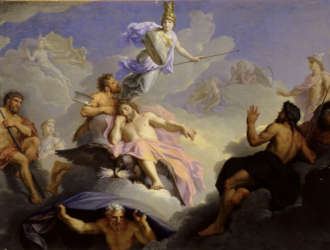 This, however, didn't solve the problem for Zeus because he was having a painful headache that wouldn't go away and was getting worse, When he couldn't bear the pain anymore, he sent for Hephaestus or, according to some sources, for Prometheus to smite his head with an axe. Upon doing so the earth shook, making a horryfing sound, and the seas trembled. The heaven itself was thrown out of balance when Athena jumped out of the head as an adult, with a spear in her hand and dressed in armour. The gods were shocked and in awe of the bright-eyed goddess. Zeus was surprised and amazed and favoured his daughter.
It is said that all this happened near the river Triton in Crete, that she was then raised by the god Triton and became also known as Tritogenea. The god had a daughter Pallas who was Athena's companion and together they practiced the arts of war. Once a routine training match between Athena and her companion Pallas turned tragic. As Pallas moved to strike what could have been a fatal blow, Zeus distracted her to protect his daughter. In that fatal moment of confusion, Athena struck Pallas instead, mortally wounding her. Devastated by grief, Athena carved a wooden image in Pallas’s likeness, wrapped it in the aegis, and placed it beside Zeus in memory of her lost friend.
Becoming patroness of Athens
Athena was said to have contested Poseidon over the land of Attica. Poseidon came to the land first and struck his trident hard in earth on the acropolis, creating a well with streaming water, which was called the Sea of Erechtheus. Although it was a marvel to behold, the water turned out to be salty and not so useful for the people. Athena came after and planted an olive tree into the hole that she made with her spear, with Cecrops as her witness. People were delighted with olives, olive oil and quality timber and they were leaning towards Athena. It was later adjurned by the gods that the land should go to Athena who then founded the very first city in the established world. The citizens named the city of Athens after the goddess and olive tree became a symbol of peace, wisdom and triumph.
Poseidon then, according to Apollodorus' Library, out of anger flooded the Thriasian plain that laid Attica under the sea. Alternatively, according to Hyginus' Fables, he wanted to flood the land but was restrained by Hermes at Zeus' command.
In another version of the story, according to Ovid's Metamorphoses, Poseidon gifted a horse, which sprang forth after striking the trident, to the people instead of a well with water but result was the same as the gods adjurned that olive as a gift surpassed the horse.
It is also said, in Diodorus Siculus' Library of History, that Helios told the people of Attica that the first people to offer sacrifices to Athena would forever be protected by the goddess and would ever enjoy her presence. And that is how she might have become the patronnes of the city.
Awkward relationship with Hephaestus
Even though she was dedicated to chastity she was given to Hephaestus as a mate by Zeus to resolve the issue of Hera being bound to the magical chair that no other god could unlock.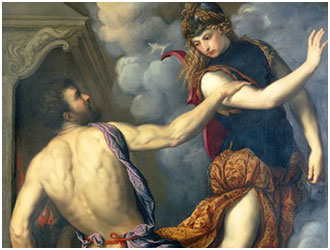 Hephaestus desired her dearly and was waiting patiently for an opportunity to embrace her. Athena was not interested in any of this other than living together. However, one day she desired new weapons and came to his workshop with a plea but Hephaestus saw this differently and began pursuing her. He wanted to embrace her but Athena refused to submit, so he dripped his seed on her leg. Disgusted by his act, she wiped the seed with wool and threw it on the ground. And from the earth Erichthoneus, a giant serpent, was born.
Some sources indicate that it was Gaea who made this birth possible and credit her as the mother of the serpent, while others simply say that Athena was its mother. Anyhow, Athena felt responsible for the creature and raised it secretly in her precinct. The creature was then hidden in a chest which she committed to Pandrosus, a daughter of Cecrops. She ordered her to guard the chest, never to open it. But Pandrosus' sisters Aglaurus and Herse opened it out of curiosity and were consequently killed by the serpent or, driven mad by Athena, they threw themsleves down from the acropolis.
It is said that Erichthoneus then took control over the city of Athens and expelled the previous king Amphictyon. The creature then became a king of the city and set up the wooden image of Athena on the acropolis and instituted the festival of the Panathenaia.
Alternatively, it is said, in Hyginus' Astronimica, that when Erichthoneus was born, Athena hid it and gave the chest to the daughters of Erechtheus. After they've opened it and died the serpent fled to the precinct of Athena and was raised by the goddess.
Gigantomachy
Athena had a prominent role in the war against the giants. She confronted many giants, wearing full armor with the head of Medusa mounted on her breastplate which turned them to stone, defeating them without the use of weapons. One such encounter was said to be against Pallas. His brother Damastor wanted to avenge his brother and attacked the goddess, throwing what he thought was a weapon but was instead his brother's petrified body. Alternatively, she flayed Pallas and used his skin to protect her body in battle.
Another one was Echion, being unaware of the power of Medusa's head, he sought to fight Athena and was turned to stone. Palleneus got close enough to attack her with a sword but part of him got petrified. Athena finished him off with her sword from close range.
She also fought and pursued Enceladus and ended his life by throwing an island of Sicily on him. Her bravery and expertise, however, wasn't enough, none of the gods powers were. Before the start of the war, the gods were prophesied that in order to defeat the giants, they would need help from a mortal hand.
Athena helped to recruit Heracles on their side and summoned him to the battlefield of Pallene where he killed many giants but was having extreme difficulty to end the life of Alcyoneus who was immortal in his homeland. Heracles was advised by the goddess to drag the injured giant out of his homeland where he finally died.
Trojan war
Athena supported the Greeks during the Trojan war, mostly because she was not chosen by Paris as the "fairest" of the three goddesses. She promised him to become the bravest warrior and skilled in every craft but Paris chose Aphrodite, who promised him the love of the most beautiful woman on earth, instead.
At the beginning of the war, Athena persuaded Achilles to resolve the conflict with Agamemnon to unify Greek troops so that they could proceed their war against Trojans. At the crucial point in war, she interfered and manipulated Pandarus to shoot an arrow at Menelaus to break a truce between Greeks and Trojans, while at the same time deflecting the arrow to only cause a minor injury to Menelaus.
Athena acted as a strategist and inspired the troops, moving through the ranks with her divine aegis and at times directly interviened in the battlefield. She protected and empowered Diomedes with godly strength and ability to distinguish gods from mortals. She guided him to kill Pandar and later wound Ares with his spear. Ares was unable to see the goddess, because she was wearing the helm of darkness, and the incoming danger. When Ares was removed from the battlefield, there was really no one who could stop the killing spree of Diomedes. The women of Troy prayed to Athena in her temple to protect Troy by stopping Diomedes but the goddess refused their prayer.
She also saved Odysseus by deflecting the spear of Socus, preventing the worst. Yet the war was at stalemate because at the other side, Hector was being similarily protected by Apollo on Zeus' orders because Zeus favored Hector above all other heroes. After seeing all the slaughtering, Athena descended from Olympus and met with Apollo to negotitate a temporary cease fire and rather resolve the conflict by an individual duel of heroes. They agreed that Hector should challange any Greek warror to a single combat. He did so and went on a rampage. Athena and Hera wanted to interviene but were restrained by Zeus.
When she could finally influence the war from behind the scene, Athena empowered Achilles by enhancing his appearance and placing the aegis upon him, surrounding him with divine aura as he prepared to re-enter battle. She amplified his voice and equipped him with nectar and amrosia. With her help, Achilles would later end the life of Hector in a duel.
When the gods were finally given a green light by Zeus, to pick a side and interviene directly to help their favourites, Athena confronted Ares in combat. She blocked each of his attempts and, when the opportunity presented itself, she picked a large stone and threw it at him, hitting him in the neck. Ares collapsed to the ground and couldn't move while being taunted by Athena who was claiming her superiority in warfare. Aphrodite came to rescue Ares but Athena made her fall right next to him, demonstrating that she can deal with multiple gods at the same time.
At the final stages of the war, when Achilles died, Athena made sure that his arms were given to Odysseus. Contrary to Homer, where Odysseus was the one who came up with the plan to construct the Trojan horse, it is said in Hyginus' Fables that it was Athena who influenced Epeus to construct the wooden horse of remarkable size.
Helping heroes in their quests
One of the first heroes that Athena helped was Cadmus in his quest to found the city of Thebes. It is said that she advised him to sow the teeth from the dragon he killed and later procured him the kingdom of Thebes after serving to Ares for eight years. Cadmus and Harmonia were given a robe, a flute and the renowned necklace as wedding gifts by the goddess.
Athena also helped Heracles on many occasions. During the labours, she gave him brazen castanets which, by clashing them, he used to scare the Stymphalian birds away and completed the task. After Heracles killed the Lernean Hydra, Athena instructed him to disembowel the creature and dip his arrows in its bladder to become venomous which would aid him in his further quests. She also guided him to safely bring Cerberus from the underworld and gave him a robe and weapons that helped him defend Thebes from Minyans. When Heracles was about to die, Athena carried him off to heaven and helped him ascend.
Athena helped Perseus in his quest to defeat Medusa. She lent him a polished bronze shield and guided him into the lair where he was able to see medusa indirectly through the reflection of the shield, avoiding her petrifying gaze, and beheaded her.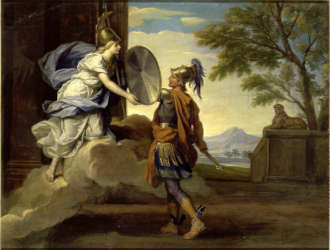 When Perseus was returning items from his quest, he gave Medusa's head to Athena which she inserted in the middle of her aegis or, alternatively, in her breastplate and used it in battles, most notably during Gigantomachy. The goddess also helped the Argonauts with building a ship of fifty oars named Argo which was the best ship ever built. It is said that at the prow of the ship she fitted in timber from the oak of Dodona. During their voyage, when they were on the way to Colchis and were nearly squeezed by two gigantic rocks, Athena came as the two rocks suddenly started closing in on each other and used her strength to hold the rocks until the Argonauts came trough. It is also said that Athena and Hera, thorugh the favour of Aphrodite, influenced Medea, a daughter of king Aeetes, into falling in love with Jason and in this way help the Argonauts.
Athena was also helping Odysseus on his journey back home from the war. She was there at every move, got his son Telemachus to act and gave his wife Penelope hope when she was in despair. At the end Athena revealed herself and enforced lasting peace between Odysseus and the suitors.
The goddess also helped Bellerophon tame Pegasus and clothed Pandora with silvery raiment and taught her the art of weaving and needlework.
Notable transformations
One of the more notable myths was the weaving contest that the goddess was challanged to. It all started when Arachne, who was of humble origin, quietly became famous for her unmatched skill in weaving. Fame got into her head as she arrogantly claimed that her skill was superior to Athena's. The goddess wanted to resolve the issue wisely and peacefully at first. She disguised herself as an old woman and warned Arachne to show humility or else she would be punished by the gods. In her hubris, Arachne refused and challanged the goddess directly for everyone to hear.
Athena had no choice but to reveal her true nature and accept the challange. The contest began and Arachne made a tapestry that was technically flawless as if it was made by Athena herself which enraged the goddess who in anger destroyed the tapestry and struck Arachne. The girl was ashamed and wanted to commit suicide but Athena transformed her into a spider and condemned her to weave forever.
Another myth was about a princess Nyctimene who was an innocent girl that got abused by her own father, King Epopeus. In shame, she fled to the forest, hiding from the light until she was transformed into an owl by Athena. An owl was granted the ability to see in the dark and became sacred to Athena, it became a symbol of wisdom.
In another account, when the famous inventor Daedalus attempted to kill Perdix out of jealousy and threw him down from a sacred place, Athena saved the boy during the fall by transforming him into a partridge bird which flew away, losing the boy's identity but kept the name.
The most famous transformation was the one of Medusa who was violated by Poseidon in Athena's temple. The goddess took it personally, as if Medusa was the one who descecrated her temple, and transformed her hair into living snakes. She would then help Perseus end her life and use her head with its deadly gaze as an important weapon.
Other myths
Curious to see the fountain of Pegasus, Athena traveled to Mount Helicon to visit the Muses. Muse Urania told her that Pegasus had struck the ground with his hoof, bringing the waters to life. Athena wandered the area and was enchanted by its beauty. She found it the perfect place for learning and inspiration. It soon became the place she would go to and which she held dear.
In another account, Athena was said to have blinded Tiresias by covering his eyes with her hands when he saw her dear nymph Chariclo naked. The goddess also had numerous priestesses, one of them was Iodama who entered Athena's temple at night where the goddess appeared to her wearing a tunic with the head of Medusa on it. When Iodama looked at the tunic, she was turned to stone by the deadly gaze.The other priestesses mentioned were Tritea, a daughter of Triton, and Phoebe who became in love with Castor.
In a separate myth, Athena was hoping to grant Tydeus immortality with the gift from Zeus after he was wounded by Melanippus. But Amphiaraus, suspicious of her plan, gave Tydeus the head of Melanippus to secure him a victory. When Tydeus reacted in the way that horrified Athena she withdrew her gift and immortality was denied to him.
Sources
To learn more, you may explore the sources and notes about Athena yourself