Hera, goddess of marriage and childbirth
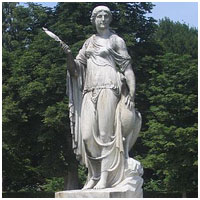 Hera (Juno) was a goddess of marriage, women and childbirth. She was known for taking special care of married women, protecting them and ultimately becoming their symbol. Having experienced childbirth and being a mother herself, she was also a protector of women in labor and often was invoked by pregnant women for protection and safe delivery. Being married to Zeus, Hera was also known as the queen of heaven and a goddess of heavenly realms, usually described as one of the fairest goddesses on Mount Olympus.
On the other hand she was jealous and vengeful towards those who hurt or crossed her, mostly at Zeus, who cheated on her numerous times, and his mistresses. However, because she couldn't hurt him, she pursued and tortured his mistresses and illegitimate children. Contrary, Hera was faithful to her husband and was showing her anger and frustration through disobedience which irritated Zeus.
It is said that Argos was her sacred city and that she was also very fond of Sparta and Mycenae and the island of Samos.
Appearance in the works of art
Most of the time, she is depicted wearing a diadem, a jewelled ornament in the shape of a half-crown, and holding a pomegranate, a symbol for fertile blood and death, in one hand and a sceptre in the other, symbolizing sovereignty. She was often accompanied by Graces and Seasons.
Myths of Hera, her marriage, influence, jealousy and more
The following grouped sections are available:
- The Sacred marriage
- Her children
- Life and influence on Olympus
- Pursuing mistresses and illegitimate children
- Spells and transformations
- Trojan war
- Other myths
The 'Sacred' marriage
Hera was the daughter of Cronus and Rhea. She was the last born female goddess who had two sisters and three brothers. Hera married Zeus after being tricked by the god's desire and transformation.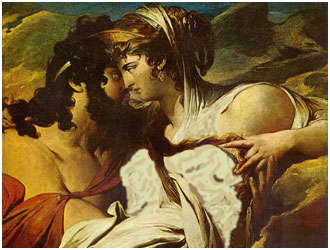 It all started, when Zeus fell in love with her and courted her unsuccessfully. He then exploited her empathy towards other beings by transforming himself into a cuckoo and settling on a mountain called Cuckoo, formerly Thornax. One day, when Hera was traveling alone in the vicinity, he cast a violent storm which brought her to the mountain where she took shelter. A cuckoo flew down to her knees, shivering from the cold. Hera felt pity and wrapped it in her cloak to warm it. Zeus then transformed himself back into original state and took advantage of her. Hera was ashamed but refused the union because of her mother. Only after being promised by Zeus to make her as his wife she agreed to marriage.
It is said that the sacred wedding took place near the river Theren, somewhere on the island of Crete. It was celebrated with honours and sacrifices when Hera became a queen of Olympus. Even Gaea was happy and presented tree blossoms with golden apples in her honor. The queen admired the gift so much that she asked Gaea to plant them in the gardens near Mount Atlas. Hera also placed a guardian to prevent Hesperides, daughters of Atlas, from picking apples from the trees.
Her children
From the sacred union of Hera and Zeus came Ares, Hebe, Eileithyia and, according to some sources, Hephaestus. Alternative belief was that Hera gave birth to Hephaestus on her own without the intercourse as a response to Athena emerging from Zeus' head. There is another version of the story, in Homeric hymn to Pythian Apollo, where Hera gave birth to Typhoeus to bring chaos to mankind because she was angry at Zeus giving birth to Athena.
It is also said, in Nonnus' Dionysiaca, that with Zeus she gave birth to Harmonia and Aphrodite. According to Hyginus there were also Iuventas (Youth) and Libertas (Liberty) which are likely divine personifications of Zeus and Hera.
Life and influence on Olympus
Being a queen and wife of Zeus, Hera was very influential goddess on Olympus and beyond. She had three nurses at her disposal. Their names were Euboea, Prosymna and Acraea, they were daughters of Asterion. She herself was a nurse and caretaker of the Graces, overseeing the development of social harmony among gods and mortals.
She also had a personal messenger and representative, the goddess Iris, that she would send to perform tasks or strike a deal on her behalf. One such example was when Hera sent Iris to summon Hypnos (Sleep), unwilling to let Halcyone go on praying to the dead. Unaware that her husband Ceyx had died, Halcyone still begged for his safe return. Iris persuaded Sleep to appear in her dream as Ceyx and gently reveal the sorrowful truth.
Hera often argued and opposed Zeus and his decisions, once even plotted a coup with Poseidon and Athena who tried to tie him up but Thetis saved Zeus by calling Briareus, one of the Hekatoncheires, who stopped them. Hera also got herself hung from Olympus for trying to drown Heracles at the sea on route from Troy. Zeus put two anvils on her feet and tied her wrists, leaving her hang in pain for all to see. The anvils and knots were enchanted so no one could save her, except for her son Hephaestus, a master craftsman, who consequently got cast out of heaven for rescuing her.
But Zeus still loved his wife nonetheless and once intervened when a mortal man Ixion, who was a cupbearer on Olympus, fell in love with Hera and made his move. Hera, however, saw it coming before it happened and reported it to Zeus. The king of the gods made a cloud in the shape of his wife and, thinking it was Hera, Ixion apporached it and laid next to it. The cupbearer later boasted that he enjoyed the queen of heaven and was consequently bound to a wheel, spinning through the air for eternity.
In her free time, the queen enjoyed the company of birds, especially Peacock and Cuckoo which were very dear and sacred to her. Hera also received two horses from Poseidon, named Cyllarus (Bowlegs) and Xanthus (Bayard) and it is said that she gave Xanthus the ability to speak. They were later given to the Dioscuri, Xanthus to Castor and Cyllarus to Pollux.
Pursuing mistresses and illegitimate children
Hera was very jealous of other goddesses and mortal women that Zeus showed interest in and could turn their lives into a living hell. Often, when she found out about Zeus' infidelities, she was angry to the bits and, being unable to punish her husband, took revenge at his lovers and children. One such account was when Hera found out that Leto was pregnant with Zeus. She was pursuing her from place to place, threatening communities into rejecting the goddess, preventing her giving birth and also sent the giant Tityus to violate her.
Another was the unbearable hate towards Alcmene who was prophesied to give birth to the most powerful son of Zeus. Hera tried crippling the child by forcing Alcmene into a premature childbirth but Heracles was destined to be born strong and healthy. The queen then redirected her efforts to harm Heracles and tried multiple times, by sending serpents to kill him while still an infant, driving him into madness to commit a murder of his own children, trying to drown him at the sea and working against him in the labours towards his redemption. She even plotted against his companion Hylas for aiding the hero, arranging for him to be seized and killed by the local nymph after he trespassed into her domain. Only after his death and ascension to heaven did Hera finally accept Heracles.
The queen goddess was also responsible for destroying mortal princess Semele who was pregnant with Dionysus. Semele was killed by the trickery of Hera but the baby managed to survive and was later born with the help of Zeus. The jealousy and harassment then transferred to Dionysus who was constantly pursued in one way or another.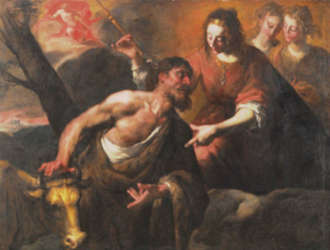 Hera was also very suspicious of her servant Io and once approached her and Zeus unexpectedly. Trying to cover up the affair, Zeus transformed Io into a cow but Hera demanded the cow as a gift. The cow was then taken far away from Zeus and put under guard by one-hundred eyed Argus. When Argus was killed by Hermes, Io was left without a guardian and roamed around the lands until coming to Egypt where she gave birth. Io was later given a pardon by Hera since she became a mother and suffered a long painful journey, throughout the barren lands of nothing but heat and desert sand, in the shape of a cow.
Hera’s jealousy also fell upon Callisto. When Zeus seduced her and she became pregnant, Hera took her revenge. She transformed Callisto into a she-bear, condemning her to wander the wilderness in silence and fear. Alternatively, according to Apollodorus' Library, Hera turned Artemis against her own companion. Mistaking Callisto for a wild beast, Artemis shot her down or the goddess of the hunt did so because she failed to keep her maidenhood.
Another mortal woman was Aegina who was taken, according to Hyginus, to the island of Delos and got pregnant by Zeus. When Hera found out, she sent a serpent to the island to poison the water source. It is said that those who drank the water paid the debt to nature.
Spells and transformations
Wraths of Hera
Beside cursing Heracles with madness and transforming Callisto into a she-bear, there were other cases in which Hera used her divine powers to inflict pain or bring justice. One such example were the guardians of Dionysus, the tribe of horned creatures known as Lamian Pheres, sons of Hyads. Because they were helping to conceal the unfavored god and trying to deceive her, she transformed them by using magic in a combination with treacherous flowers of Thessalian Achlys. From that point on, they appeared as creatures with long ears, horns, big white teeth and horse's tail.
Ino, Semele's sister, and her husband Athamas also became victims because they raised and helped Dionysus. Hera cursed them with madness and it is said that Athamas killed their elder son Learchus and, to escape husband's madness, Ino threw herself and their younger son Melicertes into the sea.
Antigone, a daughter of Laomedon, and Pygmy queen were both transformed because they dared to compare themselves with the goddess. Antigone boasted that she was as beautiful as Hera and was transformed into a silly chattering stork that praised her beauty with her ugly beak. The Pygmy queen claimed equality to Hera was transformed into a crane, a bird that resembled anything but royalty.
Another casualty was a nymph Echo who distracted Hera with endless chatter about herself and her tales while Zeus slipped away undetected by his wife. However, when Hera uncovered the deception, she turned the nymph's gift into punishment, depriving her speech of its freedom and leaving her able only to repeat the words of others, echoing forever.
Similarily, the queen goddess took away the ability to see from Tiresias because he settled an argument by confirming Zeus' opinion that, while making love, the pleasure of a female was greater than of a male which Hera disagreed on. To compensate the blindness, Tiresias was gifted prophetic powers and long life by Zeus and became a famous seer.
Mercy of Hera
Not all spells were cast in anger but rather to end pain. In one such account, Ethemea, a nymph, was killed and taken away to the underworld by Persephone. Her husband Meropes was devastated and grieved in so much pain that he wanted to commit suicide. Hera felt pity and transformed him into an eagle and placed him among constellations.
Hera also felt deep sorrow for the daughters of Pandreus because they were left orphans when the gods killed their parents. The goddess eased their pain by blessing them with wisdom and great beauty, surpassing that of mortal women.
Trojan war
During the Trojan war Hera supported Greeks because she was angry at Paris for not picking her as "the fairest" of goddesses. In the famous dispute between Hera, Athena and Aphrodite, Zeus wisely passed on the responsibility of declaring the fairest goddess, that would have the rightful claim to the apples of Hesperides, to Paris Alexander. Hera promised him the kingdom of Asia but Paris chose Aphrodite who promised him the eternal love of Helen, the most beautiful woman on earth.
According to Homer's Iliad, Hera went down to the battlefield in her chariot, taking Athena with her, and motivated the Greek soldiers by shouting loud, so loud as if it were fifty men shouting, and covering the battlefield in fog to slow down the Trojans who were driving the Greeks back.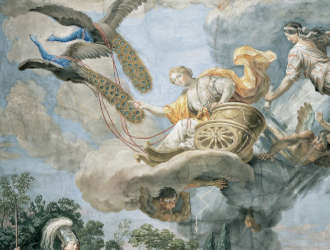 In a plot to restore balance in the war, Hera seduced Zeus and made love to him into exhaustion and pressured Hypnos to put him into deep slumber. Hera then overrode Zeus direct orders not to engage, allowing Poseidon to intervene directly and turn the tide against Trojans. Later, when the gods were given a green light to engage directly and support their favorites, Hera was opposed by Artemis who thought of giving the queen a lesson. The result was quite the opposite as Hera easily disarmed her, grabbing her hands in one hand and bow in the other, and smacked her on the face. Artemis then fled the battlefield in tears and went to Olympus to complain to Zeus.
It is also said that Hera saved Menelaus from certain death, put the thought into the mind of Agamemnon to prevent Hector from lighting the ships on fire, and had Achilles saved from drowning in the river Scamander and, through Thetis, influenced the hero to return Hector's body.
Other myths
It is said that Hera favoured Odysseus for his ingenuity in conquering Troy and win the war, thus helping him in his quest of returning back to Ithaca.
She was also heavily involved in the Argonauts' quest to obtain the Golden Fleece, where she helped Jason and Medea but only as far as until her plot against Pelias was successful. Pelias was said to have angered the goddess by desecrating her temple, for he killed Sidero in it, and Hera only stopped her actions after his death.
In another myth, Hephaestus, who was cast out of heaven, forced the gods to invite him back to Olympus. He sent a gift to his mother, a magical golden chair with invisible feathers. Surprised and excited, Hera sat on the chair and triggered the trap. She was instantly bound and no one on Olympus could release her. The gods were later, with the help of Dionysus, able to convince Hephaestus to let her go.
During Gigantomachy or the War of the Giants, Porphyrion wanted to violate Hera and was already tearing her robe apart. Hera called for help and Zeus struck the giant with a thunderbolt in time and prevented the worst. Even before any of the wars, in early days, Hera is said to have helped hiding Zeus from his father Cronus. She saved him from being eaten by taking him to the Curetes.
Sources
to Hera
To learn more, you may explore the sources and notes about Hera yourself