Dionysus, god of wine, festivals and pleasure
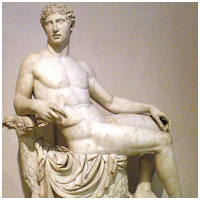 Dionysus (Liber, Bacchus) was a god of wine, festivals and pleasure. He was credited of discovering the vine plant and teaching men how to cultivate it and mastering the art of making wine from its fruit. Having traversed the inhabited world, he shared his gifts with the locals and was worshipped because of it, gaining many followers. There were many festivals held in the god's honor, including the controversial Bacchic mysteries, usually celebrated at night in a state of Bacchic frenzy. It is said that Dionysus rarely traveled alone but was usually surrounded by a large group of Satyrs, Maenades or Bacchants, devoted followers who shared in his revelry. They were not just his company, but at times his army, ready to fight if needed. Together they lost themselves in celebration, while the god himself was known for indulging in life’s more intimate pleasures.
Dionysus was also the only god that was born twice, of the same father and two different mothers, thus being called Dimetor (twice-born). Though he inherited the legacy of an earlier Dionysus, he ultimately surpassed it in fame, influence, and the impact of his gifts. Being harassed by Hera, his journey brought him to the eastern edge of the planet now known as Asia and made him known worldwide as he fought many battles and held as many festivals.
Whenever he went abroad, Dionysus was said be accompanied by Silenus, his personal advisor and attendant, and Muses as he continued to enjoy their songs and dancing. During assemblies he wore brightly coloured and luxurious garments.
Appearance in the works of art
The younger Dionysus was depicted as a youthful and beautiful man, wearing a wreath of ivy on his head called mitra, to ward off headaches caused by drinking. He held thyrsus, a light staff wrapped with leaves of ivy, in one hand and a cup in the other. He was usually accompanied by a troop of Satyrs and Maenades. Sometimes, likely the first born Dionysus, he was depicted as a fully grown man with a large beard.
Myths of Dionysus, his wanderings, affairs and divine recognition
The following grouped sections are available:
- The first Incarnation
- The second birth of Dionysus
- Wandering around the world
- Finally recognized as Divine
- His lovers and descendants
- Festivals of Dionysus
- Gifts and Transformations
- Other myths
The first Incarnation
There was another, the first Dionysus, that was born in earlier times to Persephone in Crete, after Zeus changed his form into a serpent and mated with her. Back then he was known as Sabazius or Zagreus and was represented wearing a horn. Even as a child, he was said to be very powerful, excelled in sagacity, and could wield lightning like his father. His ability to make a good judgment was demonstrated by attempting to yoke oxen and successfully use them to sow fields. It is said that he was raised in the city of Mesatis and that his birth and honors were celebrated at night and in secret.
Hera, however, was jealous and angry at his powers and fame and conceived a plot against his very existence. Even though the god was sagacious, he was still a youth and unknowingly fell for the trap, set up by the goddess. Hera distracted him with a mirror which was fascinating, seeing reflection for the first time. While he was there playing, she called for the Titans she previously conspired with. They came aggressively and, having realized the plot, the god tried to escape by changing forms. He tried transforming into a lion, into a horse, into a serpent and into a bull but was in the end torn into pieces by the Titans.
The second birth of Dionysus
The second coming of Dionysus began when Zeus fell in love with a mortal woman of exceptional beauty called Semele, a daughter of Cadmus. They were having an affair since Zeus was already married and it is said that Zeus mixed a heart of previous Dionysus, torn to bits, in her drink and made her pregnant.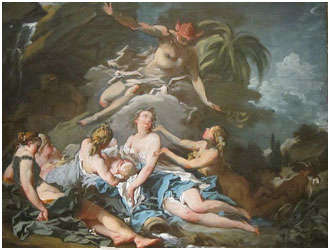 When Hera found out about the pregnancy she disguised in Semele's maid Beroe and gave her false advice to ask Zeus to come and make love to her the same way he did with to wife so she would know the true pleasure of sleeping with a god. Unable to refuse her request, Zeus came to her chamber in a chariot accompanied with lightnings and thunderings and embraced her but Semele couldn't endure the overwhelming divine presence and perished in fire. Zeus managed to save the child from Semele's womb and sewed it in his thigh. When the time was right, he entrusted the child to Hermes who brought him to Ino and her husband Athamas.
However, when Hera found out that child was still alive and where he was being raised, she drove the couple mad to the point of killing their own children. Hermes was once again activated and found him a safe shelter with a group of nymphs of Nysa, daughters of Helios, in Asia, away from the eyes of many.
It is said that because he was raised in Nysa and his father was Zeus, who was also known as Dios, he got the name Dionysus. The god spent his childhood with these nymphs and discovered the vine and how to make wine. But the good times did not last long because Hera drove him mad and his path guided him around the world. It is also said that Zeus tranformed the nymphs into stars, naming them Hyades.
Wandering around the world
In his madness, Dionysus roamed through Egypt and Syria and was at first received and welcomed by Proteus, the king of Egypt. Later on, his path brought him to Cybela in Phrygia, where he was nurtured and purified of madness by Rhea. The goddess also shared her knowledge about the initation rites and gave him the costume used in the rituals. When he was travelling through Thrace, he came to the kingdom of Edonians where King Lycurgus, a son of Dyras, insulted and expelled him, dismissing his cult, and captured his followers. In shock, Dionysus took refuge in the sea where Thetis, the mother of Achilles, embraced him.
After recovering, he returned, liberated his followers, and drove Lycurgus mad to the point of killing his own son with an axe, thinking he was cutting a vine branch. The god then gave an oracle to Edonians that the land would stay barren as long as Lycurgus lived which ended in having him bound to Mount Pangaeum and left to be consumed by the wild horses.
Having roamed Thrace and India and set up pillars, he then traveled to Thebes, where he was a witness of great insolence by King Pentheus who dismissed him as a god and tried to prevent his rites. The local women, on the other hand, were enchanted by the god and came to rave in Bacchic frenzy to Mount Cithaeron. When Pentheus came to the mountain to spy on the Bacchanals, he was torn to pieces by his mother Agave who, in her madness, saw him as a wild animal.
Having proven to people of Thebes that he was a god, Dionysus visited Argos where he was met with similar reception. Because they didn't honor him, he drove mad their women to the point of cannibalistic endeavour. These poor souls were later healed by a healer Melampus.
Finally recognized as Divine
At the ceratin point in his journey, the god tried to reach the island Naxos from Icaria and hired a ship for transport. The ship, however, was in command of the Tyrrhenian pirates who had other plans.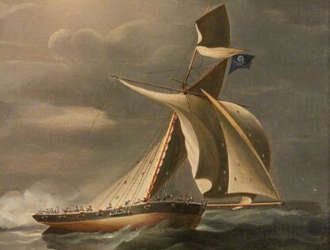 In the proximity of Naxos the pirates turned their ship to Asia, planning to sell him as a slave. There was a man on board, called Acoetes, who recognized the god and urged others to respect the deal and honor him. They refused to listen and when they were tying him on the deck, suddenly the sounds of flute were heard and heavenly smell arose before the ship got covered with ivy and vine plants as Dionysus transformed oars, sails and ropes into lions and panthers. Out of fear, the pirates jumped from the ship into the sea. Upon falling into the water, they were transformed into dolphins. Acoetes alone was spared and became the god's devoted follower.
There are slightly different variations of the myth among authors, the difference being the ship transformation and the reason why they pirates jumped into the sea but the transformation of pirates into dolphins and Dionysus being recognized as a god remain the same. For example, contrary to Ovid's Metamorphoses, in Apollodorus' Library, Dionysus transformed a ship mast and oars into snakes instead of sails and ropes into panthers and lions and drove the pirates mad, or, according to Homeric hymn to Dionysus, Dionysus himself transformed into a lion and siezed the helmsman before others jumped into the sea.
Additionally, according to Hyginus' Astronomica, the pirates were in trance by the melody and cast themselves into the sea during the dance. They were transformed into dolphins and one of them was put among constellations, known as Delphinus, as a reminder for sailors to behave.
His lovers and descendants
The love of his life was Ariadne, a daughter of Minos, who was taken away by the god after she was left behind by Theseus on the island of Naxos. Dionysus loved and cherished her dearly. Their sons were Eurymedon, Ceramus, Philas, who was said to have dwelt by the springs of Asopus, and Oenopion, who learned from his father the art of making wine. It is said that Ariadne was killed by Artemis because of something Dionysus said but no further detail was provided. Dionysus cherished her even after death and placed her among stars known as the crown of Ariadne.
Dionysus once bedded Aphrodite when they were drunk and it resulted in her giving birth to Priapus, a minor rustic god. In another accound, Dionysus was once a guest to Oeneus and fell in love with his wife Althaea who would later give birth to Deianira. Oeneus left the city in despair and pretended to be performing sacred rites but Dionysus wanted to make amends and it is said that Oeneus was the first who received the vine plant from the god and was also taught the process of making wine, thus it was called Oinos (wine).
The other sons of Dionysus mentioned were Narcaeus by Physcoa, Thoas, Phanus and Staphylus.
Festivals of Dionysus
There were many festivals held in the honor of Dionysus but the most traditional was Dionysia which was originally a simple and merry procession. Participants would simply bring vine branches, jugs of wine and baskets of dry figs and would observe a caravan of billy goats and people carrying phallus, a symbol of fertility and prosperity. The festival eventually, according to Plutarch, evolved in an unpleasant way with people starting to appear in more extravagant clothing, wearing masks and were showing off with their accumulated wealth. Traffic columns of carriages were passing by, presenting chests of gold and luxurious items. It was no longer just a merry procession.
The other popular yet controversial celebrations were the Bacchanals or Bacchic rites.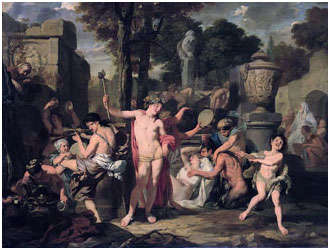 These rituals were also known as the Mysteries of Dionysus which consisted of loud music, wild dancing and wine drinking, causing an ecstatic state known as the Bacchic frenzy. The rites were organized in a way where women gathered, the maidens were carrying thyrsus and joined in frenzied revelry, crying out 'Euai' repeatedly to honor the god. Matrons were formed in groups and offered sacrifices to the god and celebrated, clashing on cymbals and singing hymns. While the initiation rites were specifically held during the night, the festival wasn't limited to the period of the day but could instead last multiple days together.
According to Diodorus Siculus' Library of History, participants would indulge in revelry, drinking unfiltered wine and could become madmen striking themselves with wooden staves. Because some of them were wounded and some died of wounds, Dionysus was offended and, instead of preventing them from drinking unfiltered wine, ordered them to carry a narthex, a fennel, instead of wooden staff. This way the madmen at least couldn't get seriously injured. Those who misbehaved towards women during the rituals were said to be punished by the god. One such example was Butes who poorly treated Coronis. He was struck with complete madness and lost his mind, throwing himself into a well and died.
There were many more festivals held in the god's honor, one of such was a festival called Tyrbe which was celebrated in Arcadia, near the spring of Erasinus river, and featured gatherings and sacrifices.
Gifts and transformations
Beside the vine plant and process of making wine and mixing it with water to avoid madness, Dionysus also discovered Zythos (beer), a no lesser drink made out of barley as a substitute for lands that were unsuited to cultivate vine. Dionysus was also said to be the inventor of thymelic contests, dancing competitions around the altar (thymele), and was the first in organizing music concerts and introducing spectator seats.
While Dionysus was leading his army into India, his personal advisor Silenus wandered away and came to the palace of King Midas who honored the god by keeping Silenus safe and entertained generously. In return Dionysus granted the king's wish and gave him a divine gift to turn everything he touched into gold. Midas was ecstatic but the merry mood lasted only for a while before he figured out that he was unable to consume food so he asked the god to take away his gift. He was then advised to take a bath in the river Pactolus which healed him but turned golden upon making contact with the king's body. The gift transferred to the river which became rich in gold and was from that point on known as Chrysorrhoas.
In another account, Dirce, his devoted follower, was accidentally killed by an untamed bull during the rites on Mount Cithaeron and the god transformed her body into a spring Dirce which was a sacred site of the city of Thebes. Dionysus was also said to have passed on a two-handled jar of gold to goddess Thetis, the jar which was made by Hephaestus for the god.
Other myths
During Gigantomachy or the war of the giants, the younger Dionysus was specifically targeted by the giants in order to destroy his existence, just like the Titans were called to do so in the past. Instead the Olympian gods prevailed and Dionysus was said to have confronted the giant Eurytus and killed him with his thyrsus. Dionysus also once fought Triton because the sea god attacked the women of Tanagra who wanted to purify themselves in the sea before the Bacchanals and it is said that Dionysus managed to overcome Triton, saving the women that were about to be initiated in the rituals.
In another myth, when Dionysus was visting Attica to celebrate the new king of Athens, he was welcomed by Icarius and, because of the generosity shown by his host, taught him the art of making wine. Icarius was eager to share the god’s kindness with mankind and he went to some locals to present the wine. Not knowing its effects, they thought it was witchcraft and consequently killed Icarius.
Next day, his daughter Erigone was looking for him and the dog Maera helped her find the body. She was so devastated that she hanged herself. Dionysus was angered and brought drought to the land of Athens and afflicted their women with frenzy which caused them into hanging themselves. By consulting with Apollo, Athenians softened the wrath of Dionysus by honoring and celebrating the deaths of Icarius and Erigone each year.
Dionysus was also involved in the myth of Hephaestus in which he was the only one that was able to bring the God of Craftsmanship to Olympus and convince him to release Hera from the magical chair that she was bound to. The chair to which no one, except Hephaestus, had the key. After saving her, Hera eventually made peace and accepted Dionysus.
The god was said to had traveled to the underworld in search for his mother. After being successful in resurrecting Semele, Dionysus changed her name to Thyone and made her immortal by ascending to heaven.
Sources
To learn more, you may explore the sources and notes about Dionysus yourself