Hades, god of death and the dead
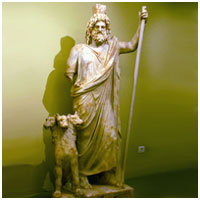 Hades (Aides, Aidoneus, Pluto, Orcus) was a god of death and the dead. He was also known as the King of the underworld because, after the war with the Titans, he received the realm of the dead under his control. Hades was rarely seen outside his domain but was allowed to have powers also on earth. Therefore people, who were still alive, were reluctant to swear an oath in his name because they were so afraid of him coming for them as it was believed in those times that he could hear the voices calling his name. To some of them even saying out loud 'Hades' was frightening.
Hades was also known as a god of hidden wealth which referred to fertile soil as well as to the precious metals, such as silver and gold. He was believed to have control over everything that was buried.
Appearance in the works of art
Hades is often depicted as a grown man with longer curly hair and long beard. Sometimes, he is depicted in the company of his pet and sacred creature Cerberus, the multi-headed dog.
Myths of Hades, his realm, the underworld, marriage and more
The following grouped sections are available:
- Ruler of the death realm
- The Underworld or, simply, Hades
- The Helm of Darkness
- The abduction of Persephone
- Other myths
Ruler of the death realm
Hades was a son of the titan couple Cronus and Rhea. He was supposed to dwell on Mount Olympus with his brothers and sisters but, after the victory over titans, the trio of him, Zeus and Poseidon drew lots to divide the rulership of Cosmos. Zeus got the sky, Poseidon got the seas, and Hades received the unseen place of the underworld away from earth, seas and sky, where the souls of the dead went upon leaving the world.
From the world of the living he couldn't hear anything else but the voices of those who called his name and the names of the dead. The trio also agreed that they can intervene on earth at any time they want but on the condition that they would keep their true identity a secret because Zeus wanted for mankind to write their own destiny.
Even so, Hades was rarely seen on earth because he had his hands full with the Underworld where he was dubbed as merciless ruler who would often go mad due to lack of moral discipline. He was considered stubborn, never kind, and could not be persuaded by any means. To make things worse for the inhabitants of the underworld, their living conditions were just dreadful and even Hades himself feared of this chaos being exposed to other gods and mortals.
There is also an alternative story provided by Hyginus who claimed that Hades was cast under the earth at birth by Cronus because he feared of being dethroned in the future so his faith was sealed from the start which would explain his anger, relentlessness and having no regard to any rules. Hades, however, was not alone down there ruling the pits, he was accompanied by Cerberus, Fates and Furies (Erinyes) and it is said that they all served and answered to him.
The Underworld or, simply, Hades
The underworld, also called Hades, was a region where souls went after separating from their bodies. They took the shape of their former bodies and were transported to an entrance of the underworld. It was thought to be the subterranean region beneath the depths of the earth and waters.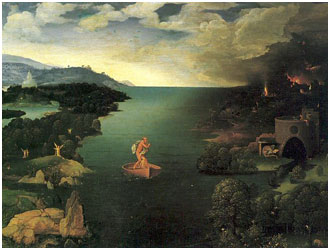 There were many entrances to Hades such as rivers, chasms and bottoms of the lakes. The main five rivers, which led to the underworld, were Styx (river of Hatred), Acheron (river of Pain), Lethe (river of Oblivion), Phlegethon (river of Fire) and Cocytus (river of Wailing). Upon reaching the underworld, there were four main regions, where the souls could rest. The Tartarus was the lowest region, also referred as never a part of Hades itself. It was a place far beneath the underworld, where the Titans were imprisoned. It is also said that Sisyphus was imprisoned there for cheating death, condemned to roll a boulder up the hill for eternity. Each time he nearly reached the top, the massive rock would roll back down, making his miserable task a never ending story.
Above Tartarus, at the lowest region of the underworld, there was a place, called the Fields of Punishment, for the souls of those who committed crimes against gods. They were sentenced to eternal punishment which suited their crimes. Then there were Asphodel Meadows for souls of ordinary men who didn't commit any significant crime in their lives but also didn't achieve any greatness or recognition that would send them to a better place, known as the Elysian fields. This was a place for the righteous and significant people and also those who were closely related to the gods, such as Cadmus and Achilles.
The Helm of Darkness
The helm of darkness or the cap of invisibility was a magical piece of armor that the Cyclopes had made specifically for Hades, during the Titanomachy, after being set free. It enabled the user to turn invisible upon wearing it. It is also speculated that after the war, the helm received even greater power, a power of controlling the dead in the underworld. Hades lent his helm for a couple of times to other gods and once to the hero Perseus in his quest to defeat Medusa. Athena was also noted wearing the helm during Trojan war when she helped Diomedes. And Hermes used it to fight Hippolytus in the Gigantomachy.
The abduction of Persephone
After taking his place in the underworld, Hades desired a bride and asked his brother Zeus to grant him one of his daughters.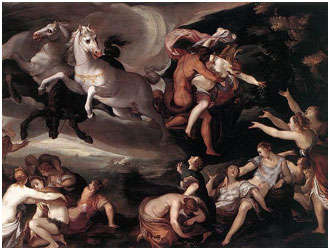 Persephone was chosen despite the fact that he knew she would resist the marriage. Regardless of her wishes, Zeus let the vicious abduction come to pass. While playing with the daughters of Oceanus at the distant fields of Nysa, Persephone was guided into a trap by magical flowers. The flowers were showing her the pathway to irresistable flower with hundred stems of fragrant blossom. When she reached out with both hands to pluck the flower, the earth opened and Hades appeared with his golden chariot, abducting her before anyone could hear her screaming.
However, two immortals, Helios and Hecate, were able to hear her plead for help. And upon Demeter's curse, which caused great drought on lands and consequently famine, it was Hecate who came to Demeter and told her about what she heard. Together they went to Helios who was able to see all deeds from both mortals and immortals. He told Demeter that Zeus and Hades were to blame. The goddess was mad and gave ultimatum that the lands would stay barren until she was able to see her daughter again.
Scared of seeing all mortals gone, Zeus finally intervened and sent Hermes to the underworld to speak to Hades. His job was to convince the god of death to let Persephone return back to her mother. After Hermes' successful persuasion, Hades was willing to let her go but, on other hand, tricked her with a honey-sweet pomegranate seed as farewell gift. Once the seed was consumed, she became bound to the underworld and would have to return eventually.
Other myths
Hades was involved in the myth of Heracles who was in the last of his twelve labors. The hero came to the underworld to capture Cerberus alive and bring him back before Eurystheus. When he met Hades, Heracles asked the god for permission to take away the monstrous beast from the underworld. Hades was surprised by the boldness and bravery of the hero and gave him the permission to take his pet on the condition that could wrestle and outmatch it. In the end, Heracles successfully brought the beast back to Mycenae. There is also another version of the story in which it was Persephone who gave Cerberus to the hero as a gift for freeing Theseus and Peirithous from the chains and bringing them back to the upper world.
This was not the only account where Heracles met Hades. According to Homer, the couple were engaged in a battle on the battlefield of Pylos where the hero wounded Hades who then enraged went to Olympus and complained to Zeus about it. Zeus calmed his brother down and asked Paeon to heal him.
In another myth, Hades and Persephone were enchanted by the music of Orpheus who was looking for his dead wife Eurydice. Hades then granted Orpheus the return of his wife back to earth. However, the god gave him a strict condition that he must not look at his wife until reaching the surface. But Orpheus looked back at his wife too soon and her shade was pulled back to the underworld.
It is also worth mentioning that Hermes was often sent to Hades to speak on Zeus' behalf and, according to Homeric hymn to Hermes, he should be appointed as a messenger to Hades because of his ability to smoothly travel between worlds but that he should expect no prize from the death god.
Sources
To learn more, you may explore the sources and notes about Hades, and Underworld yourself