Hermes, god of travel, diplomacy and trade
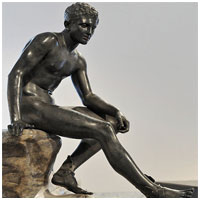 Hermes (Mercury) was a god of travel, trade, diplomacy, persuasion, writings and athletics. Many thought of him as the protector of heralds, merchants, travellers and even thieves. Hermes was credited as the inventor of new items and concepts never known before, such as the rules of trade and sending diplomatic embassies to negotiate peace during war. Mastering words and speech to a higher degree, he became a skilled communicator, good at persuasion and diplomatic endeavors. Combined with the ability to change his appearance and voice at will, he was no stranger in deceptive arts.
Very early, Hermes was appointed as a personal herald of Zeus, helping him in numerous occasions. He was the perfect messenger because he could move freely and fast between the worlds of mortal and divine, over seas, land and the underworld. He have done many deeds for other gods and heroes.
Appearance in the works of art
Most of the time, he is depicted as an athletic beardless young man, wearing winged sandals (Talaria) and the winged helm (Petasus). He is also holding the golden wand (Caduceus) which he could use to deceive or persuade anyone. Sometimes, he is holding a staff with snakes wrapped around it instead of the wand. And on some occasions, he is even depicted as a fully grown man with a beard.
Myths of Hermes, his birth, family and ingenuity
The following grouped sections are available:
- Birth of Hermes and Apollo's cattle
- Bringer of Arts and Inventions
- His Lovers and Descendants
- Rescuing Io, mistress of Zeus
- Wraths of Hermes
- Trojan war
- Other myths
Birth of Hermes and Apollo's cattle
Hermes was a son of Zeus and Maia, a nymph and daughter of Atlas. He was born in a cave near Mount Cyllene in Arcadia and in the first hours after his birth, in a myth of Apollo's cattle,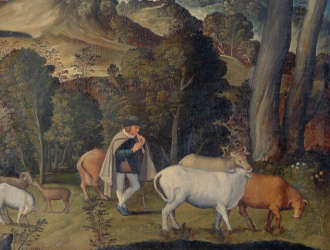 Hermes slipped from swaddling bands, that he was put in, and went to steal some oxen in Pieria which Apollo was tending there. To prevent from being discovered by tracks, he put boots on cattle's feet and led them to Pylos. He sacrificed two, pinned up their hides on rocks, boiled some of the meat for his meal and burned the rest what was left of these two oxen. From the tortoise shell that he found there and the hides of the oxen he made a lyre with binding strings, made from cattle, across the shell and also a plectrum for the lyre which elegantly complemented the user while playing this beautiful instrument.
Meanwhile, Apollo was already searching for his cattle in Pylos, asking locals for their whereabouts. The locals told him to search for a boy with cattle that they had seen passing through. When Apollo finally found him and the cattle, he heard the enchanting sounds of the instrument and was willing to trade some of the cattle for it. They made the exchange and soon after, while Apollo was tending the rest of his flock, Hermes fashioned a shepherd's pipe for his instrument to play.
It was not long before Apollo become enthusiastic over the pipe and offered him his golden staff that he carried when tending his herd. But this time, Hermes wanted more in exchange, not only the golden staff, but also the art of prophecy. Apollo was eager to get the pipe and therefore agreed on giving him the staff and the lesson. Being impressed with god's persuasion and bartering skills, Zeus enacted his will immediately and Hermes became the messenger of the gods.
Bringer of Arts and Inventions
Beside introducing a set of rules for commerce and diplomatic embassies, Hermes was said to have invented seven Greek letters (Alpha, Beta, Eta, Tau, Iota, Ypsilon) from the flight of cranes. He observed that when the cranes fly, they form letters. He also established the months and perceived the courses of constellations, explained languages to men and even introduced first wrestling schools.
Apart from the lyre, plectrum and shepherd's pipe, Hermes also invented fire sticks that became known as torches. It is said in Homeric hymn to Hermes that, when still newborn, Hermes designed a pair of sandals out of wickerwork mixed together with tamarisk and myrtle twigs. These sandals were light and would tie under his feet and efficiently conceal his tracks, after stealing Apollo's cattle. Eventually, he would also invent his famous winged sandals and the winged helm.
His lovers and descendants
Hermes once fell in love with a mortal woman Polymele when he spotted her among the singing maidens, performing a dancing act for Artemis. Later that day, he went to her room in secret and made her pregnant. Polymele gave birth to Eudorus who became a fine Greek warrior in Trojan war. There was also Chione, a maiden so beautiful that Apollo and Hermes fell in love at the same time. It is said that both of the gods slept with her the same night, Hermes being the first, using his wand to deceive her. She got pregnant by both gods and gave birth to twins Autolycus and Philammon. Autolycus was given the gift of thievery by his father.
Hermes also loved and chased a mortal woman Apemosyne. He managed to catch her by setting up a trap on the path where she, upon returning home, slipped on the hide and fell and was deflowered by the cunning god. After she told her brother Catreus what happened he, not believing the story, kicked her to death. It was no secret that Hermes was an admirer of Aphrodite and it is said that the fruit or the consequence of their union was Atlantius, also called Hermaphroditus, because he had the physical attributes of both a man and a woman. To some he was a god but to others a monstrosity.
Hermes was also a father of Cephalus, who Eos loved and carried away, by Herse or, alternatively, by Creusa. According to Hyginus, he was also the father of Daphnis by a nymph Daphne, Libys by Libye, Myrtilus by Theobule, Pan by Penelope, Priapus, Eleusinius, Eurytus, Echion and Eurestus.
Rescuing Io, mistress of Zeus
In the myth of rescuing Io, Zeus asked Hermes to save his mistress Io whom Zeus himself had an affair with and was forced to instantly turn her into a cow, to hide her from his approaching wife that was looking for her priestess. When Hera saw Zeus with a cow, and heard his lame excuse, she was rightfully suspicious and demanded to give her the animal as a gift.
Zeus had no choice but to agree because, otherwise, his secret would be disclosed. Hera then called her servant Argos, the hundred-eyed giant, to take her away from Zeus and keep an eye on her.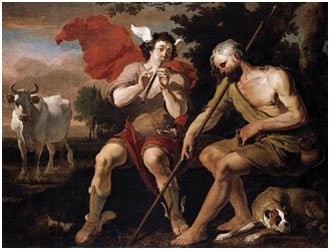 Argos had one hundred eyes and never had to close them all while sleeping, making him the perfect guard for this task. However, Hermes was able to make the giant fall asleep with the soft tunes of his pipe. When the giant's nap turned into slumber, Hermes picked his sword and chopped off his head because he didn't want to leave any witnesses. And poor little Io was finally free but still a cow. She roamed mile after mile for many years until she reached Egypt and gave birth. Then Hera finally released her from torment as, being the goddess of childbirth, she felt pity for Io.
Wraths of Hermes
There is more to the story of Apollo's cattle where a local named Battus lived on the top of the hill from where the herd were stolen. Battus heard the herd when it was driven past his house and, when he came out, realized it was stolen. However, he made a deal with Hermes and agreed not to tell anyone in exchange of reward. Then Hermes went to hide his cattle inside a cave by the cliff near Coryphasium and came back to Battus transformed into another person to test his oath.
He offered him a robe, if he could tell of noticing a herd of cattle being driven past his house. Battus took the robe and told him about the cattle. Hermes was furious to be lied to and so easily double crossed. In revenge, he turned the man into a stone statue with his staff. The same thing happened to Aglauros, a sister of Herse, when she demanded gold for her sister and prevented the god from entering their house.
Trojan war
During the war Hermes mostly acted as the herald of Zeus, delivering messages and enacting the king's orders. When the gods were finally allowed to pick a side and intervene on the battlefield, Hermes was opposed by Leto who, along with her children Apollo and Artemis, supported Trojans. However, in the dialogue between the two in Homer's Iliad, Hermes told the goddess that it would be unwise to fight those close and very dear to Zeus and that she might tell other gods to have conquered him by strength, if she wished to so, thus refraining from combat.
After Hector was killed by Achilles, who in anger and revenge dragged Hector's body around on display for days, gods kept urging Hermes to steal the body. Finally, after nine days of quarreling about what to do, Zeus, who himself favored Hector, sent Hermes to guide Priam to the Greek camp to retrieve the Hector's body. The messenger god made sure Priam entered undetected and safely escaped with the body once Achilles agreed to return it.
Other myths
Hermes was also involved in many myths of other gods and heroes. For instance, he rescued Ares from bonds when the god was abducted by Aloadae giants and helped Perseus in his quest to defeat Medusa.
During Gigantomachy or the war of the giants, he fought and slew giant Hippolytus while wearing the helm of darkness.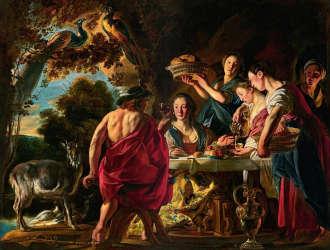 However, when Typhoeus attacked heaven he, with the rest of the gods except Zeus, fled to Egypt and transformed into an ibis. Later, according to Apollodorus' Library, he was responsible for recovering the sinews of Zeus and restoring his father's powers. There were also tasks that he had done on behalf of Zeus, such as helping Odysseus, giving him a potion that prevented the hero to fall under the spell of Circe as well as bringing command to the nymph Calypso to release the hero from captivity and let him continue his journey back home.
Another notable task was when he traveled to the underworld delivering orders to Hades that Persephone should return to Olympus to be reunited with her mother, because Demeter was unwilling to lift the curse of barren lands. Another such occurrence was also when a huge argument broke out between Aphrodite, Athena and Hera about who is the fairest goddess. Hermes was tasked by Zeus to take them to Mount Ida to Paris Alexander for judgment.
On behalf of Zeus, Hermes was also tasked with saving Dionysus and taking him to the nymphs of Nysa, to bind Prometheus to iron spikes on Mount Caucasus and Ixion to a wheel in the underworld for attempting to violate Hera.
Interestingly, it is said, in Hyginus' Astronomica, that when Hermes was still an infant Hera suckled him, thinking he was her son. However, when she found out he was a son of Maia, she thrust him with such force that the whiteness of the flowing milk appeared among the constellations, known as the Milky Way.
Sources
To learn more, you may explore the sources and notes about Hermes yourself