Artemis, goddess of archery, hunting and wilderness
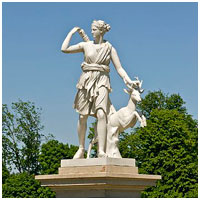 Artemis (Diana) was a goddess of archery, hunting, wilderness and wild animals. Being a virgin herself, she was known as the protector of young girls and virgin nymphs but also of women in labor. Artemis was described as pure with strong moral integrity, very brave, confident and independent, preferring intact wilderness over settlements. Even though Artemis was a well established goddess at Mount Olympus and often visited other gods, presenting them her trophies, she spent most of the time in forests, mountains and plains, hunting and hanging out with nymph companions.
It is said that she had sixty virgin nymphs, daughters of Oceanus, for her choir and twenty nymphs of Amnisus as her handmaidens.
On the other hand, Artemis was also childish and impulsive and very vengeful towards those who offended her or her family. She could bring plagues and curses to entire lands and cities, killing crops and cattle and even people in a form of disease or miscarriage. Or she would simply bring sudden death with her arrows or wild beasts, sometimes even in a cruel way with transformations.
In contrast to her twin brother Apollo, Artemis was associated with the night time of the day, sometimes even moon, and it is said that she could summon night at will.
Appearance in the works of art
She is often depicted as a young beautiful huntress, holding a bow with both hands, aiming at her target. In some art works, she is depicted as a winged goddess, holding a stag and a leopard or a lion. Also other art works associate her with night time and the moon, depicting her hunting under the moonlight.
Myths of Artemis, her birth, chastity, wraths and wayward life
The following grouped sections are available:
- Birth of the Twins
- Becoming a huntress
- Sacred lands of Artemis
- Protecting her chastity
- Wraths and Vengeances
- Trojan war
- Other myths
Birth of the Twins
Artemis was a daughter of Zeus and goddess Leto. She was born in a myth where Leto was constantly pursued by Hera and her minions, chasing her from place to place and threatening communities from welcoming her, thus preventing her giving birth. However, Leto found refuge at the island of Delos which happened to be her sister Asteria who turned herself into an island to escape Zeus' embrace.
Artemis was the first who came from her mother's belly. This weakened Leto and the birth of her twin brother was at risk but Artemis helped her mother to safely deliver Apollo. Due to her experience, having witnessed childbirth early on, Artemis became a protector of women in labor and it is also said, in Diodorus Siculus' Library of History, that she is called Kourotrophos or a child-nurturer because she discovered how to tend to young children and what foods are suitable for babies.
Regarding communities which rejected Leto when she sought refuge while in labor, it is said, in Pausanias' Descriptions of Greece, that they were visited and punished by the twins.
Becoming a huntress
When still very young, Artemis went to the Cyclopes, strongly convinced they were the answer to equip herself with a bow and arrows. Despite their frightening appearance, she fearlessly approached them and calmly asked for the items.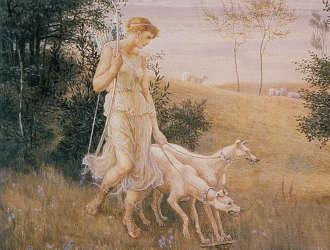 It turned out she was right all along as they fulfilled her wish and fashioned a well-bent bow and a quiver of arrows, once again demonstrating their skill to create divine weapons for gods. In return, Artemis promised to bring them dinner as soon as she slayed a wild creature or a monstrous beast. She went hunting deer and spotted a mighty herd at the Parrhasian hill, five specimens with golden horns, larger than bulls, worthy of her first kill. The goddess hunted down four of them but one escaped and would later become known as the Ceryneian hind that Heracles needed to capture in one of his labors.
It is said that she often had companions in hunting, most notable of which were Daphnis, who pleased the goddess by playing pastoral songs on shepherd's pipe, Callisto, who also swore to remain a virgin but was seduced by Zeus and consequently killed by Artemis, and Orion, who, in some versions of the myth, she killed and placed among constellations.
The other mentioned hunting companions were Celaeno, Eurybia, and Phoebê. It is also said that, having devoted her life to chastity, Artemis favored female characters who rejected traditional roles, especially other huntresses such as Atalanta, Britomartis, Procris and Cyrene.
Sacred lands of Artemis
It is said that because of her purity and harmony with the nymphs, the gods granted Artemis the island of Ortygia (Delos). The nymphs created a fountain, called Arethusa, on the island to please the goddess. Alternatively, according to Ovid's Metamorphoses, a nymph Arethusa was relentlessly pursued by the river god Alpheus. In agony, the nymph prayed to Artemis who answered by hiding her in a cloud. The goddess then transported her to Ortygia and transformed her into a spring.
Brygean Isles, mostly untouched, were islands dedicated to Artemis and it is said, in Apollonius Rhodius' Argonautica, that Jason killed Apsyrtus in the vicinity of the temple on one of the islands. Artemis was also closely associated with the locations of Arcadia, Crete, Taygetus and Scythia.
Protecting her chastity
There was a time when river god Alpheus strongly desired Artemis and pursued her constantly. Tired of running, the goddess camouflaged herself and all of her nymph companions in the mud. The god couldn't distinguish her from the landscape and eventually gave up in his pursuit.
Another attempt on her chastity came from Aloadae giants and brothers Otus and Ephialtes. Artemis tricked the giants by transforming into a deer and jumping between them. In desire to kill the animal, they struck each other with their own spears, causing fatal wounds, and died.
The goddess also seemed to zealously cherish her privacy. In a myth, where a huntsman Actaeon saw her naked while bathing, Artemis transformed him into a deer and drove mad his fifty dogs. The huntsman was consequently torn apart and eaten by his own dogs because they saw him as prey. Alternatively, according to Diodorus Siculus, Actaeon provoked the anger and wrath of Artemis claiming to be a better hunter and through his corrupt ritual practices where he improperly sacrificed the spoils of the hunt to the goddess for his own pleasure, presuming upon marriage with a goddess who has no part in marriage.
It is also said, in Pausanias' Descriptions of Greece, that Buphagus, an Arcadian hero, attempted to violate Artemis which resulted in getting himself killed by the goddess.
Wraths and Vengeances
In a shared myth with her twin brother Apollo, she was sent to kill seven daughters of Niobe who mocked Leto for having only two children. This offended Leto who sent Apollo and Artemis to kill her children.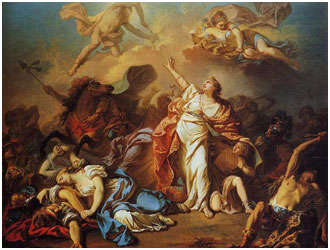 Artemis killed the daughters with her bow and arrows, just like her twin brother did with Niobe's sons. In another myth, where Oeneus, a king of Calydon, forgot to donate her offerings for annual sacrifice of the first fruits, Artemis sent a powerful wild boar of enormous size in order to ravage the herds and the town. The people of Calydon respectively fought back and, with the help from Atalanta and the best hunters from other lands, managed to overcome the beast and kill it. Even though the goddess protected the beast by repeatedly knocking down arrows aimed at it. In anger, Artemis inflicted discord between the camps involved in the hunt which resulted in many casualties.
Another casualty of Artemis' wrath was giant Tityus who attempted to violate Leto and was hunted down and killed by the twins. Chione was another one who provoked the goddess by boasting against her in the hunt and sleeping with Apollo and Hermes in the same night. Artemis shot an arrow through her tongue as a lesson. The inflicted wound proved to be lethal and killed Chione.
Ethemea, a nymph, was also shot by the arrows of Artemis after she stopped worshipping the goddess. It is said that Persephone carried the nymph to the underworld herself. The goddess also killed Laodamia, the daughter of Bellerophon, when the hero angered the gods, and Coronis, because she cheated on Apollo with Ischys, as well as Ariadne because of something Dionysus said.
Trojan war
During the war, Artemis favored Trojans because at the very start of the war Agamemnon wounded her sacred deer and boasted to be a better hunter than the goddess. In revenge, she cast a storm, preventing the Greeks from sailing for Troy, and demanded Agamemnon's eldest daughter Iphigenia to be sacrificed. Agamemnon at first refused, but with the intervention of seer Calchas and Odysseus, and after realizing there was no other way, gave in. When Iphigenia was about to be sacrificed, Artemis pitied the innocent girl, cast mist on the spot, substituting a deer in her place, and transported her to the land of Tauri where she became a priestess in the goddess' temple.
That was not the only reason why Artemis favored Trojans, it seemed to be a family thing because her mother Leto and her brother Apollo also supported them. With combined effort they saved Aeneas who was wounded on the battlefield and brought by Apollo to his temple where the hero's wounds were tended by Artemis and Leto.
When the gods were given a green light by Zeus to engage in the battlefield, Artemis foolishly confronted Hera who easily disarmed her and smacked her on the face, giving her a lesson. Artemis fled the battlefield in tears and retreated to Olympus, straight to her father's lap.
Other myths
During Gigantomachy, Artemis killed giant Gration but when Typhoeus attacked heaven, she fled with the rest of Olympians, except Zeus, to Egypt and transformed into a cat.
It is said, in Callimachus' Hymn to Artemis, that, even though Artemis preferred wilderness, Zeus granted her authority over thirty cities and a role as a watcher of streets and harbors.
There were also accounts where natural death was governed by Artemis and Apollo. For example, in Homer's Odyssey, Odysseus described the island of Syrie (Syros), where no famine or sickness was known to man. Instead, when they grew old, Artemis and Apollo killed them with gentle arrows, symbolizing painless death. This was demonstrated when Penelope, the wife of Odysseus, exhausted by grief, prayed that Artemis would come and kill her instantly.
Sources
To learn more, you may explore the sources and notes about Artemis yourself