Aphrodite, goddess of love, beauty and pleasure
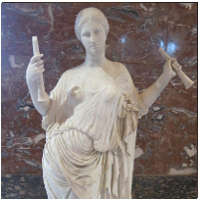 Aphrodite (Cypris, Cytherea, Venus) was a goddess of love, lust, pleasure, beauty and procreation. She was the most beautiful of all goddesses in terms of appearance but her personality was rather damaged because she was described as weak and frightened as well as ill-tempered and easily offended. She had many affairs with both gods and mortals. The reason behind this might be that she had no childhood, being born an adult, and never learned how to deal with a relationship. Her belief was that no woman should stay and die a virgin and would gladly help men charm women with love spells which she would also, without any remorse, use to plant discord or as a revenge to get even at those who offended her.
Due to her ability to encourage love and gold-like glow of being in love, the goddess was also called Golden Aphrodite but some authors are pointing out that the name came from her being covered with accessories made of gold. Aphrodite was an established goddess on Mount Olympus and was known to be in the company of other gods and goddesses, most often in the company of Erotes (Cupids), Graces and Hours.
She was also the main reason for the Trojan war when she, in exchange for the golden apple that would confirm her as the fairest of all goddesses, promised Paris eternal love from Helen, the most beautiful woman on earth and Paris couldn't resist the offer.
Appearance in the works of art
Aphrodite was usually depicted as uncovered beautiful woman with fair curly hair and bright eyes. On many occasions, she was also depicted in the company of Erotes or her lovers.
Myths of Aphrodite, her birth, love affairs, descendants and more
The following grouped sections are available:
The Birth of Aphrodite
According to Hesiod's Theogony, she was born as an adult when Uranus' testicles fell in the sea, after Cronus castrated him, which put her in the older generation when the Titans claimed the rulership of the Cosmos.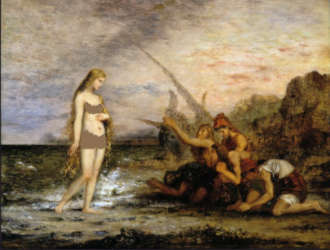 It is said that she had emerged from the foam which gathered on surface of the water. Her first step on the land was at the island of Cythera and she was named Cytherea, after the island. Soon after, she came to Cyprus and as the lovely goddess walked on the island, grass started emerging from the ground beneath her feet. She was accompanied by Eros and Pothos who followed her at her birth. Similarly, in Hyginus' Fables, Aphrodite hatched from an egg that fell into the river Euphrates and was then heated by doves sitting on it. She became known as the Syrian goddess and it was one of the reasons Syrians didn't eat fish or doves.
However, alternative sources, such as Homer's Iliad and Apollodorus' Library, claim that Aphrodite was a daughter of Zeus and a titaness Dione, a daughter of Gaea and sister of Cronus, which connected her to the younger generation of gods. Regardless of different sources, she was always depicted or had a reference of being born as an adult, nubile and infinitely desirable. She was referred as an important Olympian goddess and a part of the family on Mount Olympus.
Love affairs and her children
Divine lovers
Because of her beauty and uncontrollable desire, she was seen as a threat to interrupt peace between gods because of jealousy. Even though she was married to Hephaestus, it didn't stop her having affairs. One that disrupted the harmony on Olympus was with Ares as they were having a passionate but secret love affair. The fruits of this affair were Harmonia (harmony), Phobos (fear) and Deimos (terror). The latter two usually accompanied Ares into battles, causing fear and terror before destruction. When Hephaestus caught her in action and called for other gods to witness this adultery, Ares was banished from heaven and Aphrodite left to Paphos in Cyprus.
Aphrodite was generally believed to be the mother of Erotes which include Eros (love), Anteros (counter-love), Himeros (sexual-desire), Pothos (yearning). However, for each of these, there are many sources connecting them to other origins and bloodline. For example, according to Hesiod, Eros was a primeval god that accompanied Aphrodite from the moment she was born while, according to Nonnus, Pothos was a descendant of Iris and Zephyrus.
Aphrodite was also noted for having a short affair with Dionysus, a god of wine and pleasure. They succumbed to the pleasures of love under the influence of wine and Aphrodite then gave birth to Priapus, a minor god of fertility.
She was also seduced by Hermes and gave birth to Hermaphroditus, born with physical attributes of both a man and a woman. To some, he was a god, to other an abomination.
Another of her lovers was Nerites, a young sea-god. She loved spending time with him and wanted him to join her at Olympus, even granting him the ability to grow wings so he could fly with her. When the god refused, preferring his life with siblings, Aphrodite in revenge transformed him into a shell and gave his wings to Eros.
Mortal lovers
Most notable among mortals was Adonis, a beautiful youth that was born out of forbidden love of Smyrna towards her father. It is said that, because Smyrna failed to honor Aphrodite, she was enchanted with a passion for her own father. She shared the father's bed without his knowledge for a dozen nights and got herself pregnant. When he found out, he wanted to end her life but she prayed to gods to turn her invisible and was transformed into a myrrh tree, also known as Smyrna. Ten months later the tree burst and Adonis was born.
Because of his beauty, the child was taken by Aphrodite who hid him in a chest and gave him to Persephone in the underworld to be taken care of and hidden from the rest of goddesses and women. When Adonis reached boyhood, Aphrodite came for him but Persephone, who also fell in love with Adonis, refused to give him back. Their quarrel became so fierce that Zeus had to intervene and find a compromise. Afterwards, Adonis was set to spend one third of the year with Persephone and one third with Aphrodite. As for the final third he was free from clasps of the goddesses but he chose to spend it with Aphrodite. One day, when Adonis was spending his time in Aphrodite's care, he went into a forest and was killed by a wild boar because of the anger of Artemis. Aphrodite was devastated and from her tears, and Adonis' blood, roses and windflowers sprang up. The soul of Adonis descended into the realm of the dead, where he was welcomed by Persephone. However, because of the divine agreement, his cycle was annual in which he lived, died and was reborn. Consequently, so was the grief of the goddesses which returned again and again while he was away.
There was also Cinyras, a father of Smyrna, who was bold enough to transfer Aphrodite's lustful celebrations from night time to day time in order to defy a local harlot from his own country. Cinyras was called a darling of Aphrodite who courted him until his daughter dismissed and disrespected her.
Aphrodite also fancied Phaethon, a son of Eos and prince of Athens. When he was still a boy with childish thoughts, the goddess seized him and made him a guardian of her shrine. Phaethon had a son Astynous and Aphrodite was believed to be the mother.
The goddess also desired Anchises, a handsome mortal shepherd living on Mount Ida, from the moment she saw him. She disguised herself as a beautiful mortal princess and seduced him, claiming they were destined to marry. Overwhelmed with desire, Anchises took her as his wife. After making love, Aphrodite revealed her true form which terrified him of imminent punishment, because he slept with the goddess, but was reassured he won't be harmed. She even told him about his son who would become a powerful leader of Trojans and eventually gave birth to two sons, Aeneas and Lyrus.
She once saved Butes, one of the Argonauts on their voyage, when he was lured into the water by the Sirens. She carried him off to Sicily where he became her lover. Aphrodite later gave birth to a son Eryx.
Love spells
Aphrodite was known for casting love spells and tampering with lives of both gods and mortals. It is said that she could make anyone in love, well almost. The only three goddesses immune to her spells were Athena, Artemis and Hestia because all three pledged to eternal virginity. Others, however, were subjects of her mercy that could receive a blessing or a curse which would improve or complicate their lives.
One of the examples was Pasiphae, a wife of king Minos, who fell in an unnatural love with the bull among the king's flock because she failed to make a single offering to the goddess for several years. Pasiphae went as far as instructing Daedalus to make a device for mating with the bull and later giving birth to the Minotaur. Aphrodite also helped Minos conquering Nisus, a king of Megara, by putting a spell on the king's daughter Scylla who fell in love with Minos and brought him his father's purple lock of hair which an oracle decreed would bring victory. Scylla later threw herself in the sea to avoid pursuit for betrayal.
In another account, the goddess caused Orsedice, Laogore, and Braesia, daughters of Cinyras, to fall in love with foreigners which at the time was a disruptive and shameful act. Disgraced by themselves, the daughters ended their lives in Egypt.
Out of jealousy, Aphrodite once sent Cupid to punish Psyche, whose beauty rivaled her own and who was worshipped like a goddess, by making her fall in love and marry. But when Cupid saw Psyche, he fell in love instead, turning the goddess’s revenge into an unexpected passion.
The goddess would also divert others away from her loved ones. One such example was Eos who once bedded Ares. The dawn goddess was consequently made to be perpetually in love and fond of both gods and mortal men. Similar thing happened to Helios for reporting her affair with Ares to Hephaestus. He was put under the love spell and helplessly observed Leucothea's whereabouts and affairs with his sun rays. Another such case was Clio who once taunted her unfortunate relationship with Adonis. She blindly fell in love with Pierus, a son of Magnus, and forgot about everything else.
The goddess was also said to have put spells on Zeus to be in love with women unknown to Hera which resulted in many affairs and births of godly and heroic children but also turmoil at Olympus. Zeus, however, returned the favour and put a spell on Aphrodite to be in love with a mortal man, so she too would experience how it felt to be in an uncontrollable love with a mortal.
Aphrodite once helped Menelaus find peace when his heart burned with thoughts of vengeance for his wife's betrayal. He wanted to end her life but after the intervention of the goddess his anger and doubt were swept away, allowing him to see her as his one true love and embrace happiness once more.
There were others, such as Callirrhoe, a daughter of Oceanus, Psamathe, a daughter of Nereus, Circe, a daughter of Helios, even Gaea, who became in love with Tartarus and gave birth to Typhoeus, that were put under the love spell by Aphrodite.
Trojan war
Aphrodite was the main cause for the start of the Trojan war. It all began when Eris, a goddess of discord and rivalry, appeared at the wedding of king Peleus and sea-nymph Thetis. Because of her discovery, that she alone had not been invited to the ceremony, she threw a golden apple to a banquet table, saying that the fairest among goddesses should take it. The problem appeared when Aphrodite, Hera and Athena tried to claim the prize and started arguing.
When the argument began escalating, all looked at Zeus to be the judge but he couldn't decide because all three were very dear to him. He came up with a solution and ordered Hermes to take them to Mount Ida to Paris Alexander for judgement, letting the free will of mortal man decide. Athena and Hera promised him power and glory while Aphrodite promised him eternal love from the most beautiful mortal woman on earth, Helen of Sparta. She was already a queen, married to king Menelaus but Paris chose Aphrodite and set things in motion as he traveled to Sparta and took Helen right under the king's nose and brought her to Troy. Menelaus then initiated the conflict which led to war.
Aphrodite then naturally supported Paris during the war and convinced her lover Ares to side with her and the Trojans. When the war was already underway, the goddess was wounded on the battlefield by the spear of Diomedes while saving her son Aeneas, a Trojan warrior at the time. She managed to save Aeneas from certain death but the spear hit her wrist and it is said that the divine fluid started flowing from her wound. Aphrodite let go of Aeneas, who was then caught and saved by Apollo, and fled in agony and fear. Iris came to save her and led her out of the crowd. Fortunately, they came across Ares who borrowed them a chariot which they used to escape from the battlefield.
Aphrodite also saved Paris from being strangled by Menelaus. She concealed him in mist and transported him to his own bedroom. She then convinced Helen to come to him immediately to tend to his wounds and offer him love and moral support. When the city of Troy fell and armies were scattered, Aeneas came across Helen while she was hiding in the temple of Hestia. He was having internal struggle whether or not to end her life when Aphrodite appeared to him in her radiant form and reminded him it was not Helen's fault for the fall of his city and that there was no honor in killing her. She advised him to instead save his family and escape from the doomed city. The advice resonated with his soul as he acted immediately and fled the city, it was the beggining of his quest to Rome.
Other myths
Many who failed to honor Aphrodite became her casualties, like the women of Lemnos. She cursed them with unpleasant odor and because their men couldn't stand the smell they fled away to Thrace where they slept with other women. The women of Lemnos were furious and killed them for dishonoring their marriages. Among the casualties was Orpheus who was torn limb by limb. His head was carried down the mountain and thrown in the sea which was carried by the sea all the way to the island of Lesbos.
In another account, Cerastae and Propetides dishonored her when they slaughtered their guests and sacrificed the remains to the gods. In revenge, she transformed them into savage bulls.
On the other hand, Aphrodite was said to favour those who honored her. One such example was Hippomenes who was given three golden apples to be able to defeat Atalanta in a foot race and win her hand. At the goddess' pleading, Poseidon transformed Ino and Melicerta into deities, granting them immortality and a place among the gods.
Out of compassion, she also came to the aid of Pandareus’ daughters, left orphaned after the gods had slain their parents. First, she cared for them and brought them to live among the gods. Then, she petitioned Zeus to grant them the blessing of happy marriages. But just as he prepared to fulfill her wish, malevolent spirits appeared, snatched the girls, and placed them under the care of the evil Furies.
Sources
To learn more, you may explore the sources and notes about Aphrodite yourself