Ares, god of war, violence and destruction
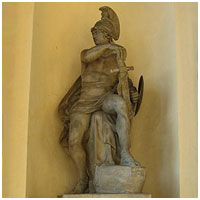 Ares (Mars) was a god of war, violence and destruction. He was associated with bloodshed, savagery and brutality and was described as the death dealer, who enjoyed chaotic warfare, the tireless and insatiable man killer and destroyer of cities. Ares was a son of Zeus and Hera and was a part of the family on Mount Olympus. He was considered as the defender of Olympus with his winged chariot and gleaming armor and a golden helmet. Being a master of combat, particularly with a shield and spear, he was often compared to Athena who was also associated with war activities.
However, while Athena was respected and appreciated for her warfare, strategy, courage and wisdom, Ares was seen as the force of destruction, savage warfare and bloodlust. No one really liked his activities because, wherever he went, he left traces of misfortune and aberration behind. Despite his unpopularity, he was worshiped and honored among Spartans and Amazons.
It is also said that the third generation of man, created by Zeus, loved the works of Ares. They were strong and violent and with a heart like adamant, had armor of bronze, lived in houses of bronze and used bronze equipment. These people of the Brazen race ended up destroying themselves in violence.
Appearance in the works of art
Most of the time, he was depicted as a young beardless warrior, wearing a helm and perhaps holding a shield or a spear in his hands. In other cases, he is depicted as a fully grown warrior, wearing armor and holding a shield in one and a sword or spear in the other.
Myths of Ares, his affair with Aphrodite, descendants and battles
The following grouped sections are available:
- Encounters with giants
- Affair with Aphrodite
- His descendants
- Sacred places and creatures
- Trojan war
- Other myths
Encounters with giants
One of the first encounters was during Gigantomachy where the gods of Olympus were opposed by a race of giants, bred for war against the order and rulership of Olympain gods. It is said that Ares, dressed in armor with gleaming helmet and equipped with a sword and golden shield, was frist to engage in a battle, attacking giant Pelorus and killing him with a single blow to the groin. He cut him in half with his sword, separating the two-bodied serpent from the chest, thus killing three entities with one strike. Feeling rage and bloodlust, Ares then proceeded trampling the giant with his chariot until the wheels were covered in blood.
To avenge his brother, giant Mimas tore the island Lemnos and was trying to hurl it at Ares but the god's javelin intercepted his intent at the last moment, shattering his skull and destroying the head of the giant. The two serpents, however, still lived, hissing vengeance.
In another account, he was captured by the Aloadae giants Otus and Ephialtes who wanted to violate Hera and Artemis. They kept him imprisoned in a brass jar for thirteen months. Ares was exhausted and would probably die in there if not for Hermes who came to rescue and secretly freed him from the clasps of the malevolent giants. The giant brothers had it coming and were in the end killed by the trickery of Artemis.
Affair with Aphrodite
During his time at Mount Olympus, he was involved in the adultery with Aphrodite who, despite being married to Hephaestus, found it exciting having sex with Ares. It became a habit for them to hook up whenever the crafting god was away. However, Helios once spied on the couple and told Hephaestus about this affair. The angry husband went into his forge and made a special net, desgined to trap them permanently. The next time, before announcing a trip to Lemnos, Hephaestus went to his marriage chamber and organized the snare around the bed. After the god left Olympus, the lovers met once again but this time, when they laid on the bed to make love, they triggered the trap and were instantly rendered immobile in a very intimate position.
Helios was on a standby and as soon as they were caught in the net, he reported it to Hephaestus who rushed back home. The lame god made a dreadful cry accross Olympus, calling out to other gods and inviting them to see what happened. Goddesses were said to be too ashamed to attend but the gods came.
For a while they were just standing there, observing and listening to the complaints from Hephaestus demanding justice. Then out of a sudden they started laughing and it was Apollo who first commented the situation, asking Hermes if it was indeed a crafty trap, catching the couple in that position, encouraging further laughter. Hermes replied that there could be three times as many nets, if that meant him laying together with Aphrodite.
Gods laughed, except Poseidon who demanded that Ares should be released. Hephaestus at first rejected the demand but, after being promised of just punishment by Poseidon, he set the couple loose. As a result of this act, Ares was banished from Olympus. He found refuge in Thrace, while Aphrodite left for Paphos in Cyprus
His descendants
With Aphrodite he had three children, a daughter Harmonia who was given in marriage to Cadmus, and two sons Phobos and Deimos who accompanied their father in battles. All Amazons are said to be the daughters of Ares that only cared about violence and giving birth to war-loving maidens. Most notable were Hippolyte, Penthesilea and Antiopa. The other three daughters were Alcippe by Agraulus, a daughter of Cercops, Melanippe and Nike (Victory).
Ares also had numerous sons, most famous were Diomedes, the Thracian, by Cyrene, Romulus and Remus by Ilia, Ascapalus and Ialmenus, heroes in Trojan war, by Astyoche and Cycnus by Pyrene. It is said that Cycnus challenged Heracles to a single combat where he was killed by the hero. This angered Ares who fought Heracles, marshalling the battle which would probably end up badly for Heracles, if they weren't parted by a thunderbolt from Zeus.
The other sons mentioned were Evenus, Molus, Pylus and Thestius by Demonice, Phlegyas by Dotis or by Chryse, Oeneus by Althaea, Melanippus by Tritea, Oenomaus by Harpine or by Asterope, Dyras, Lycus and Alcus. It is also said that Eos once bedded Ares but no children came out of it. Instead, jealous Aphrodite caused the dawn goddess to be perpetually in love.
Sacred places and creatures
The famous grove at Colchis was said to be sacred to Ares. The grove contained the Golden Fleece and was guarded by a sleepless dragon, an offspring of Ares, which Jason and the Argonauts encountered on their quest. There was also a fountain in Thebes that was sacred to Ares. The fountain was guarded by a dragon which Cadmus killed in his quest of founding the city of Thebes.
It is said, in Hyginus' Fables, that Cadmus and his wife Harmonia were later in life, after their children had been killed, turned into serpents by Ares who still held a grudge because of the dragon. However, the mentioned fountain is said to be the fountain of Castalia which was at Delphi and the transformation may not be related to the Ismenian dragon in Thebes.
There was also an island of Ares, home to the birds of Ares. They were also known as Stymphalian birds, dangerous and aggressive creatures that attacked from the air with sharp, darting feathers. It is said that one of them struck Oileus and his fellow Argonauts were stunned by the force of the so-called winged bolt.
Ares was once tried before the twelve gods for the killing of Halirrhothius, a son of Poseidon, who attempted to violate his daughter Alcippe. After proving it was a defensive act which prevented the assult, the god was found not guilty and the hill, where the trial took place, was named the hill of Ares or Areopagus.
Trojan war
Ares was heavily involved in Trojan war supporting the Trojans but at times he also fought against them, for instance killing Sarpedon who fell at the hands of Patroclus. In Homer's Iliad, he was noted leading the Trojans on the battlefield, accompanied with his frightening sons Phobos (Fear) and Deimos (Terror), as well as Eris (Strife), all of which spread among enemies.
Ares was guided by Apollo on the battlefield to remove Diomedes because he was on a killing spree, decimating Trojan troops. When Athena, who fought for the opposite side, came to help Achaeans, Ares concealed the Trojans in darkness, rendering war tactics from the opposition ineffective. Ares fought alongside Hector, sometimes in front, sometimes behind, protecting him and inspiring troops in a form of a Thracian leader Acamas.
The Argives kept moving back once they realized that Ares was among Trojan ranks killing fellow soldiers such as Isander and Periphas, who he stripped of all his weapons. The gods too have noticed as Hera complained to Zeus about good man dying by the hands of the violent god. In response, Athena was set to deal with him. She joined Diomedes on a chariot which was on the way to collision with Ares who only saw Diomedes because Athena was wearing the helm of darkness. Ares threw a spear towards Diomedes which was intercepted by Athena. It was Diomedes' turn to throw his spear. Guided by Athena, the spear hit Ares in the groin, causing him so much pain that he had to withdraw from the battle.
He went to Olympus to complain to Zeus and blamed Athena for his injury and the injury which the goddess also caused to Aphrodite, as well as the dangers of gods helping mortals. Zeus had him healed by Paeon but pointed out that he was a big hypocrite for enjoying hurting others and then complaining after the tables have turned.
It is said that Ares also lost a son Ascalaphus in the war. At that time all the gods were ordered by Zeus to refrain from battle. When Ares found out about it, rage consumed him and wanted to avenge his son,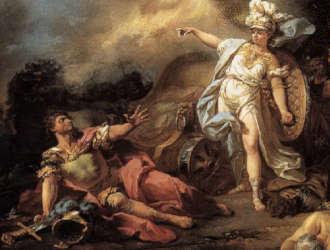 but was restrained by Athena. When the gods were finally allowed to pick a side and engage in the battlefield, Ares confronted Athena and attacked her with a bronze spear, taunting her that she would now pay for caused injuries. Athena kept blocking his attacks with her aegis and seized an opportunity to pick up a jagged rock which she threw at Ares, hitting him in the neck. His legs collapsed and his armor rang when he fell on the ground. Covered in dust he laid there motionless, listening to Athena's laughter, followed by war cry and a verbal lecture that he was no match for her to begin with. The god of war was then rescued from the battlefield by Aphrodite.
Other myths
Once King Sisyphus tricked Thanatos 'the death' into handcuffing himself and held him captive until Ares decided to rescue him, tired of men not dying even when killed in combat. He went before the king and threatened him with beheading. Sisyphus, in fear of god's wrath, freed Thanatos and turned himself in to Hades.
In another account, Ares descended from heaven to reward his son Romulus for successfuly founding and establishing Rome. He granted him immortality and took him to heaven where he became known as the god Quirinius.
Ares was also called Aphneius (Abundant). The name came after mating with Aerope who died giving birth to a child who kept feeding from the mother's breasts even after death because, by the will of Ares, there was still great abundance of milk left. The name Theritas (the fierce one) he got after his nurse Thero or, alternatively, from the fierce nature of his spirit.
The god also invented a suit of armor and was the first to arm soldiers and introduce the battle's fury of contest. To his daughter Hippolyte he gave a belt as a token of her superiority over the rest of the Amazons and lost a boxing match to Apollo during the Olympic games.
Sources
To learn more, you may explore the sources and notes about Ares yourself