Oceanus, god of river Okeanos
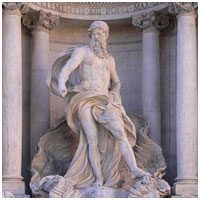 Oceanus (Okeanos, Ocean) was a Titan god of enormous river called Okeanos which was believed to be encircling the world and was connecting this world to other realms, such as heavenly realms from which the gods came and underworld where the souls of the dead lived. He was a personification of all salt water of the world, more precisely Mediterranean Sea, Atlantic Ocean and Indian Ocean which were the most familiar to ancient Greeks at the time, and all the fresh water that includes rivers, lakes, streams and rain. Oceanus was originally the source of all the water.
However, when geography became more known and accurate to the Greeks, he was placed to represent more stranger and unknown waters of Atlantic and Indian Ocean while Mediterranean Sea was ruled by a younger god Poseidon and rivers, fountains, streams and rain waters were controlled by the titan's sons and daughters.
Myths of Oceanus, his family and famous islands and shores
The following grouped sections are available:
His family
Oceanus was, according to most authors, a first descendant of Uranus and Gaea and was married to his sister Tethys. Together they gave birth to three thousand Potamoi or river gods and Oceanids, known as nymphs of rivers, lakes, streams, fountains and wells which never ran dry. According to Ovid, however, Oceanus was said to be one of the primeval deities, born alongside Gaea and Uranus.
Not interested in power and warfare
Unlike his other brothers, Oceanus, according to Apollodorus, never participated in plotting nor castration of his father Uranus. He was also not interested and never joined his brothers in the war against younger Olympian gods. Unlike Prometheus and Epimetheus, who had sided with the Olympians during the war, he rather withdrew himself from the conflict. And, because of it, he was never imprisoned in Tartarus by Zeus when the war, where the Titans had lost, was over. Oceanus is also said, according to Homer, to had never participated at the Assembly of the Gods during the Trojan war where Zeus requested for all gods to attend.
Famous islands and shores of Oceanus
Most known island was the Elysian fields or island of the blessed. It was a place where the souls of extraordinary mortals went and it was believed to be along the shore of deep swirling Oceanus somewhere in the underworld. Another known island was the rocky island Sarpedon which was, according to the fragment 21 of Greek Epic Cycle, a home of the Gorgons, including Medusa. The other two islands were Erythia and Hesperia. Erythia was the red sunset isle, home of the giant Geryon, where Heracles went in one of his labors and had to acquire the giant's cattle. Hesperia was the the evening isle in far west of the world, mostly known for its famous Garden of Hesperides which was controlled by Hera.
In the northern stream of Oceanus, beyond northern mountains, was the land of Hyperboreans. They were a blessed race, sacred to Apollo who came to live there during winter time. It is said that people there lived a long life, free of wars and diseases in the realm of eternal spring. In the southern shores of Oceanus, from the farthest east to the farthest west, was the land of Ethiopians.
Sources
on the bath of Pallas
to Oceanus
To learn more, you may explore the sources and notes about Oceanus yourself