Typhoeus (Typhon), fire-breathing colossal giant
Typhoeus was a destructive monstrous giant, a colossal figure that distrupted the very nature of the Cosmos. His mere presence was enough to block the sun and throw the moon out of balance, even the earth itself trembled. His form is described as terrifying, with the lower body of serpents and a terrifying upper body of hundred snake heads with flickering tongues, horrendous jaws hissing out terror and hideous glare emitting from all the eyes. Fire was burning from each head which produced all kind of sounds, from unsettling sounds similar to bull bellowing or lion roaring or whelps hissing that would echo over the mountains to sounds sometimes understood by Gods.
Typhoeus was an offspring of Gaea and Tartarus, risen out of anger and revenge to bring chaos to the world and to overthrow the order set up by Zeus and the Olympian Gods. According Hesiod's Theogony, Aphrodite is credited to have aided Gaea and Tartarus to fall in love and consequently give birth to Typhoeus.
Alternatively, According to Homeric hymn to Pythian Apollo, Hera was the one who actually gave birth to Typhoeus, after praying to Gaea and refusing to sleep with Zeus for a year because she was angry at the glorious birth of Athena.
Myths of Typhoeus, his offsprings, assault on gods and aftermath
The following grouped sections are available:
Descendants of Typhoeus
During his time, Typhoeus is said to have consorted with Echidna, a human-snake hybrid, and fathered all sorts of famous monsters such as Cerberus, a multi-headed hound, Lernean Hydra, a multi-headed serpent, Chimaera, a fire-breathing hybrid monster composed of parts of a lion, a goat and a serpent, Scylla, a terrifying sea-monster, Sphinx, a merciless creature with the head of a woman and the wings of a bird, Gorgon and the dragon which guarded the apples of Hesperides.
According to Apollodorus' Library, there was also Orthus, a two-headed hound, Nemean lion with impenetrable skin and Caucasian eagle set to feed on the liver of Prometheus. The latter is questioned by Hyginus who, in his Astronomica, states that many believed that the eagle was an automaton, made by the hands of Hephaestus and given life by Zeus. In Valerius Flaccus' Argonautica, it is said that Harpies, half-human and half-bird creatures, were also daughters of Typhoeus.
Attack on Olympus
Typhoeus was a vicious creature of immense size, dwarfing mountains and causing natural upheavals, including violent storms and volcanic eruptions. In Nonnus' Dionysiaca, It is said that he had other giant and serpentine creatures under his control when he attacked the gods and celestial beings.
The earth and sky were shaking, stars and constellations being dragged out of place as he engaged in a cosmic battle with the Seasons and fixed stars, distrupting natural balance.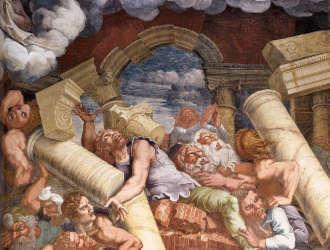 Everyone was caught in a chaotic turmoil, with Orion, the Pleiades, and other celestial figures preparing for battle. On Olympus, however, Zeus was left alone as other Olympians fled to Egypt in terror and transforming into animals. According To Hyginus' Astronomica, Hermes became ibis, Apollo transformed into a bird, Artemis into a cat, Aphrodite and Cupid into fishes. Pan cast himself into the river, making the lower part of his body a fish, and the rest a goat. According to Ovid's Metamorphoses, Apollo has transformed himself into a crow, Dionysus into a goat and Hera into a snow-white cow.
Confrontation with Zeus
As Zeus was left alone pondering on how to respond, it is said, in Nonnus' Dionysiaca, that Victory, disguised as his mistress Leto, approached and urged him to fight. She reminded him that stability of the whole cosmos is at stake. Zeus had no other choice but to confront Typhoeus and he proved to be the only one capable of standing against the giant. During battle, however, the giant managed to steal the sinews of Zeus, crippling the king of the gods and forcing him to retreat. The aid came from Cadmus, disguised as a sheperd, who was said to have deceived Typhoeus into giving him the sinews of Zeus willingly, after becoming mesmerized by the melody of the pipes played by the hero. Cadmus recovered and hid the sinews in a cave where Zeus secretly reclaimed them. What followed was a prolonged battle of cataclysmic proportions in which Zeus used thunderbolts, lightning and winds to combat Typhoeus while the giant tried to counter the attacks with water, rocks and other elements but was starting to fail.
Alternatively, according to Apollodorus' Library, Zeus confronted Typhoeus alone, first from a distance using thunderbolts to strike the monster while being pursued. When they engaged in a close combat Zeus was first to strike the giant with adamantince sickle but was eventually overpowered by Typhoeus who wrestled his sickle and severed the sinews in god's hands and feet. Zeus was captured and brought to the Corycian cave in Cilicia where Delphyne, a she-dragon maiden, was tasked to guard him and his sinews, hidden in a bearskin, separately. The maiden, however, had failed to live up to the task as Hermes and Aegipan managed to steal back the sinews and secretly restored the god's strength. After Zeus regained his powers the cosmos witnessed the final battle between the two which took place in several locations. At Mount Nysa, the Fates tricked Typhoeus into eating fruit that made him believe he would gain strength, only to weaken him further. In Thrace at Mount Haemus, Typhoeus tried to fight back by hurling mountains, but Zeus’s thunderbolts caused the mountains to recoil and wound him.
The Aftermath
In the end, Typhoeus was blasted away by Zeus' thunderbolt which disintegrated him, reducing him to ashes. There are different variations of the story regarding the location of Typhoeus’s remains.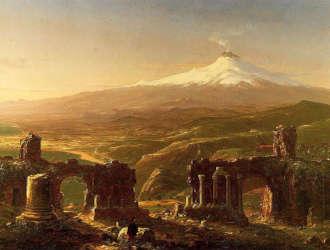 The most popular among authors places him under Mount Etna in Sicily where the giant lay helpless as a volcano. According to Aeschylus, despite weakened and immobilised, he is still capable of demonstrating volcanic activity through eruptions that create rivers of fire and devour the Sicilian fields. Hesiod and Nonnus on the other hand claim that Typhoeus was eventually cast into Tartarus while it is said in Apollonius Rhodius' Argonautica that when Typhoeus was struck by the lightning bolt, he disintegrated over the mountains and plain of Nysa and slowly descended beneath the waters of the Serbonian Lake.
According to Hesiod's Theogony, his remains also became the source of various destructive winds, wreaking havoc on the seas and lands. These winds continue to threaten humanity, symbolizing the giant's chaotic nature even after defeat. There are still beneficial winds (Notus, Boreas, and Zephyrus) but are now balanced between forces of chaos and the forces that sustain order and life.
It is said, in Nonnus' Dionysiaca, that when Typhoeus was defeated and natural order has been restored, the gods returned to their places on Mount Olympus. Athena victoriously entered Olympus unarmed, Ares walked in transformed into a celebratory figure, and Themis showing the spoils of the defeated Typhoeus as a warning to Gaea of the dangers of overstepping divine boundaries. Cadmus is rewarded, promised glory and royal legacy by Zeus.
It is also said that there was one among gods being able to leverage the giant's power in a controlled manner. Hesiod and Aeschlyus described Hephaestus sitting on Mount Etna and, through his strength, melting iron and hammering the molten ore.
Sources
To learn more, you may explore the sources and notes about Typhoeus yourself