Cyclopes, one-eyed giant blacksmiths and warriors
Cyclopes were giant creatures of immense size and strength and were described as having a single eye located beneath their brows in the middle of their foreheads, a defining feature, along with their terrifying appearance, that would scare away their enemies. They were skilled blacksmiths and craftsmen, often depicted working with fire and metals at their workshops.
They were also fearsome warriors that used large rocks, firebrands and weapons, forged by themselves, in battles that were often fought at the side of Olympian gods since they were known allies of Zeus, Three Cyclopes were born to Gaea and Uranus or alternatively to Gaea and Aether. Their names were Arges, Steropes and Brontes (or alternatively Pyrcamon) who were the first of their race and have forged famous divine items for Zeus, Poseidon and Hades.
Myths of Cyclopes, their works, the alliance and more
The following grouped sections are available:
- Elder Cyclopes and the alliance with Zeus
- Working at the anvils
- Killed by Apollo
- Other Cyclopes
- Cyclopes as bogeymen
Elder Cyclopes and the alliance with Zeus
The story of the first three Cyclopes at the beginning was a miserable one. They shared the same fate as their brothers, Hekatoncheires, as they were imprisoned beneath the earth in Tartarus by their father Uranus or alternatively by Aether as soon as they were born. This act was done out of fear and jealousy that they will become more powerful than their father. During the war of the Titans, Zeus freed them, after defeating their jaileress Campe, a she-dragon creature.
The Cyclopes, same as Hekatoncheires, have then formed an alliance with Olympians and helped them win the war against Titans. It is said that alliance was struck at the sacred altar made by the Cyclopes. This particular altar became significant when the gods used it to make first offerings and was since then used to sacrifice to the Cyclopes. To honor the alliance, the Cyclopes crafted and gave Zeus the thunderbolt, Poseidon was given the trident and Hades the helm of darkness which turned the wearer invisible.
Working at the anvils
It is said that these elder Cyclopes could be found at the isle of Lipara, a volcanic island off the coast of Sicily, in a cave working at the anvils of Hephaestus as skilled blacksmiths, in service to the gods.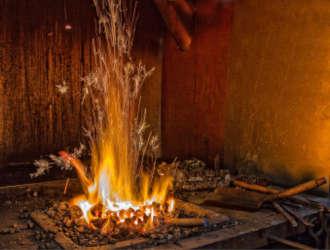 Similarly, both in Virgil's Aeneid and Calimachus' Hymn to Artemis, the place is described as the home of god Hephaestus where din of the anvil is echoing loudly, bellows are blasting hot air and fire breathing through the furnaces as projects of great importance are being worked on. According to Virgil, they have crafted a chariot with winged wheels for Ares and the Aegis of Pallas, a magical breastplate with serpent scales and gorgon imagery for Athena. They have also forged a giant shield, layered seven times, one to stand against all the weapons of Latium.
Callimachus on the other hand describes a story how goddess Artemis came to the Cyclopes while still a young girl. Despite their frightening appearance, she was fearless and asked them to fashion a well-bent bow and quiver with arrows for her. They fullfilled her wish and have once again demonstrated that they can create divine weapons for gods. In return, Artemis promised them that she would bring food on a table as soon as she slayed a wild creature or a monstrous beast.
There were other works that Cyclopes were credited for, such as fortifications of Mycenae, including Lion's gate and city wall, and a glorious circlet of emeralds glowing with a hidden fire for Harmonia, a wife of Cadmus, as her wedding gift. However, it is unclear which Cyclopes have built and crafted these.
Killed by Apollo
According to Apollodorus' Library, Zeus feared that human beings might escape death if they learned the healing art from Asclepius, a son of Apollo, and therefore struck Asclepius with a thunderbolt. In revenge, Apollo killed the Cyclopes (Arges, Steropes and Brontes) who had fashioned the thunderbolt for the king. Zeus was enraged and, having witnessed the death of his allies, wanted to hurl Apollo into Tartarus but instead, with the intervention of Leto, sent him in servitude to Admetus for a year.
Alternatively, according to Hyginus, Zeus struck Asclepius, son of Apollo, for having restored the life of Glaucus, son of Minos, and Apollo in revenge slew the Cyclopes with an arrow which he afterwards buried in the Hyperborean mountain. It is said that when Zeus pardoned his son and sent him in servitude to Admetus, king of Thessaly, the arrow was borne by the wind and brought to Apollo along with the grain which at that time was growing. This was the reason that the arrow was put among constellations.
Other Cyclopes
In Homer's Odyssey, Cyclopes were described as a tribe of crude and lawless men that don't grow their crops but put trust in immortal gods who make their lands fertile.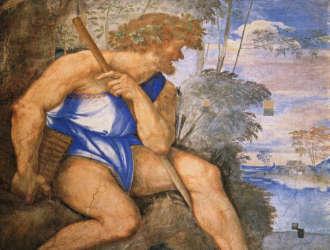 They live without any rule of law, in hollow caves among the mountain tops. Each Cyclops makes laws for his own family. They don't have boats or ships which would enable them to travel to other towns. The most famous of them is Polyphemus, a son of Poseidon and Thoosa, a nymph and a daughter of Phorcys. He is well known for his encounter with Odysseus where the hero blinded him and eventually escaped captivity. Valerius Flaccus mentions two other cyclopes Acamas and Pyragmon living in a location near Pelorum, which is a promontory on the Sicilian coast.
Other Cyclopes mentioned in the myths are Euryalos, Elatreus, Trachios and Halimedes who, according to Nonnus' Dionysiaca, joined the war of Dionysus against king Deriades and the Indians. It is said that all the Cyclopes were present except for Polyphemos who was left behind because of his love for Galatea.
Cyclopes as bogeymen
It is said that Cyclopes were used to scare children into obedience. When a child misbehaved, the mother would call upon the Cyclopes (Arges or Steropes), and Hermes was sent to carry out the task of frightening the child by playing the bogeyman until the kid ran into her mother’s lap and started behaving.
Sources
To learn more, you may explore the sources and notes about Cyclopes yourself